Aug 6, 2026
Bot Followers vs Ghost Followers: What's the Difference?
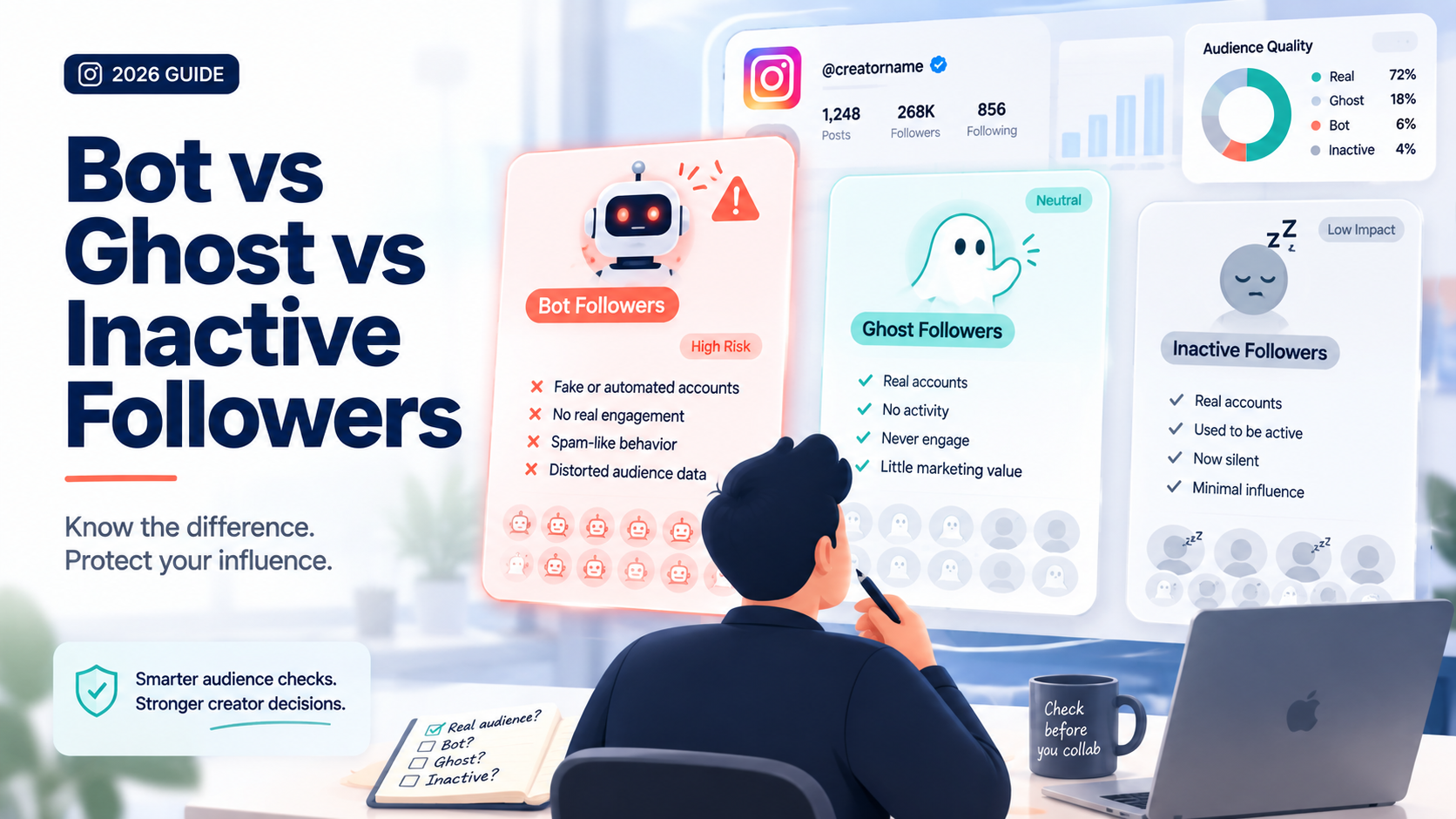
Bot followers, ghost followers, and inactive accounts all hurt your ROI differently. Learn which to prioritize when vetting creators and how each costs you.
 Melissa Tan 陈慧敏1,380 words6 min read
Most vetting guides lump all low-quality followers together as "fake followers," which makes brands treat a 60,000-follower creator with 15% ghosts the same as one with 15% bots. But the two scenarios cost completely different amounts.
The first creator's real 51,000 engaged followers might be worth paying for. Ghost followers are real people who followed but never engage. They contribute passive impressions, just with poor conversion rates. The second creator's 9,000 bots deliver nothing and actively drag down the whole profile's distribution. Bot followers are automated accounts created to inflate numbers. When Instagram pushes new content to a test segment and those accounts don't interact, the algorithm throttles distribution before the real followers ever see it. You pay for 100,000 impressions and get 6,000 real ones.
Inactive accounts are abandoned profiles that still count toward the total. They lower engagement rate but don't touch reach, because Instagram doesn't push content to accounts that never log in. Pure denominator inflation. All three lower engagement rate, but bots kill reach, ghosts just dilute it, and inactive accounts only inflate the denominator. This is which one to walk away from and which one is a discount lever.
Key Takeaways
• Bots never engage, never convert, and actively harm reach by failing Instagram's test-segment algorithm. Deal-breaker.
• Ghosts are real humans who don't interact. They contribute impressions but rarely convert. Discount factor, not deal-breaker.
• Inactive accounts are abandoned profiles. They lower engagement rate but don't touch reach. Minor adjustment.
• AI-generated accounts (2026) have realistic photos and placeholder posts. Same zero value as bots, much harder to spot.
• Under 10% combined is normal churn. 10-20% is workable if priced accordingly. Above 30% is a pass.
The Four-Type Breakdown
Type | What It Is | Engages? | Converts? | Impact on Campaign |
|---|---|---|---|---|
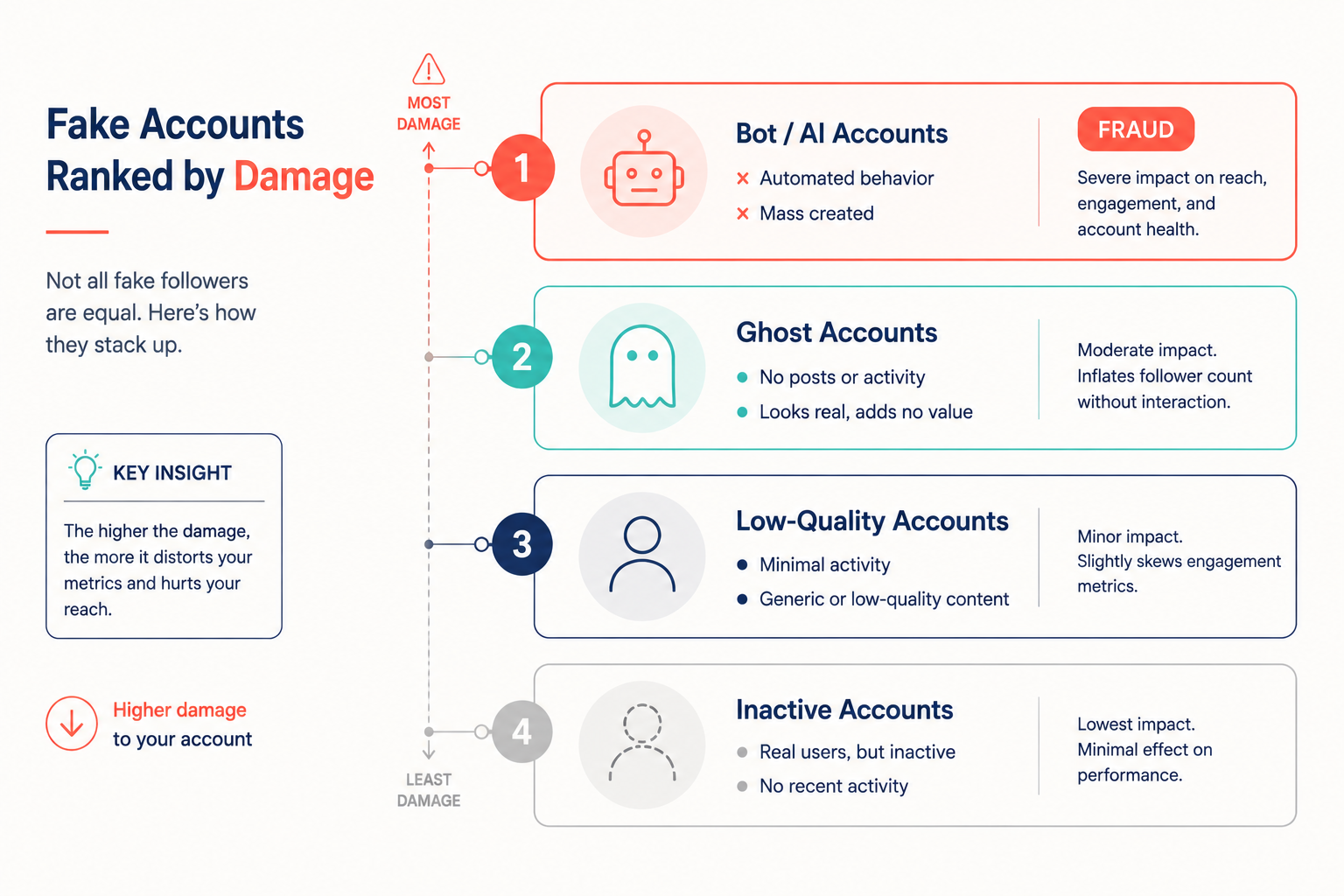
Bot followers | Automated accounts from follower panels or scripts | No | No | Worst. Zero reach + algorithm penalty |
Ghost followers | Real people who followed but never interact | Rarely | Almost never | Medium. Passive impressions, poor conversion |
Inactive accounts | Real profiles abandoned months or years ago | No | No | Low. Denominator inflation only |
AI-generated (2026) | Fake accounts with AI photos, bios, placeholder posts | No | No | Severe. Same as bots, harder to detect |
The distinction that matters: bots and AI-generated accounts are fraud. Ghosts and inactive accounts are churn. Only the first category is something the creator actively bought.
How to Tell a Bot from a Ghost
Bot markers: `user####` or random-string usernames, missing or stock profile photo, zero to three placeholder posts, empty or template bio, created under 90 days ago but already following 200+ accounts, extreme following-to-follower ratio.
Ghost markers: real name, real photo, a normal-looking grid with friends commenting on their posts. They follow the creator but never like or comment on that creator's content. Usually from follow-for-follow, giveaway entries, or old content that stopped matching their interests.
Click into 20 random profiles from the creator's follower list. If 8+ match the bot pattern, the creator bought followers. If most look real but show zero interaction with the creator's recent posts, those are ghosts.
That split changes the deal. A 40,000-follower creator at 30,000 real / 8,000 ghosts / 2,000 bots can deliver solid ROI at a discounted rate. One at 20,000 real / 5,000 ghosts / 15,000 bots is a pass.
What Each Type Costs You
Bots: zero reach plus an algorithm penalty
Instagram shows each new post to a test segment. When that segment is full of bots, nobody engages, the algorithm reads "not interesting," and distribution stops — so real followers who would have engaged never see it.
The math: you paid for 100,000 impressions. The algorithm delivered to 12,000 people, 40% bots. You got 7,200 real impressions and 6 conversions. The bot segment didn't sit neutral, it blocked reach to real users.
Ghosts: impressions that never convert
Instagram still counts ghosts in impression delivery. If a story reaches 15,000 accounts and 30% are ghosts, you got 10,500 real impressions and 4,500 that will never click through.
The math: the rate looked fine at 2.8% because real followers carried it, but you overpaid by roughly 20-25% against a clean audience. Ghosts are survivable if disclosed — a 50,000-follower account with 12,000 ghosts is a 38,000-follower account. Pay them that way.
Inactive accounts: pure inflation
The user never logs in, so Instagram never serves them the post. Denominator-only — they lower engagement rate without touching reach.
The math: if a creator charges $1,500 on 75,000 followers and 10,000 are inactive, you overpaid by about $200. Annoying, not fatal.
AI-generated accounts: bots with better camouflage
Realistic AI face, plausible bio, 3 to 8 AI-generated grid posts. They follow in bulk from panels and sit silent. The tell: their own posts have 0 to 2 likes and no comments, and the account is under 90 days old while following 400+ profiles.
Impact is identical to traditional bots — the problem is that a quick profile scroll no longer catches them. The old "empty profile" test worked in 2023. Now you have to check engagement on their own grid, not just whether the grid exists. The seven-signal vetting method covers how to spot these at the creator level.
What Each Finding Should Do to Your Offer
Finding | Action |
|---|---|
20%+ bots | Walk away, or price them at real follower count (40K with 25% bots = a 30K creator) |
10-15% ghosts | Common and acceptable. Adjust rate |
30%+ ghosts | Ask for a follower purge before signing |
Any inactive % | Subtract from quoted follower count when calculating your offer |
AI-generated present | Treat as bots. Same zero value, same penalty |
Note that engagement rate alone won't separate these — ghosts and inactive accounts drag the same number down that bots do, which is why a below-benchmark rate isn't automatically fraud. Tier benchmarks and the three legitimate reasons a rate runs low covers when the number is misleading you.
Manual spot-checks handle 20 profiles. For a percentage breakdown across hundreds, the free fake follower checker returns estimated suspicious-audience percentage, duplicate-comment rate, and meaningful-comment rate from a profile URL. It won't label individual accounts, but it surfaces the aggregate and flags when something's off.
The Takeaway
A creator with 50,000 followers and 8,000 ghosts can still deliver ROI if you price them correctly. A creator with 50,000 followers and 8,000 bots cannot — the bots actively kill reach to the real 42,000.
Identify bots and AI-generated accounts first (deal-breakers). Discount for ghosts and inactive (negotiation levers). When you're vetting more than a handful of creators, run the shortlist in CreatiVault to get audience composition, comment quality, and quality scores side by side.
Frequently Asked Questions
What's the difference between bot followers and fake followers?
"Fake followers" is an umbrella term covering bots (automated accounts), ghosts (real people who don't engage), and inactive accounts. Bots are the fully automated subset created by follower panels. Not all fake followers are bots, but all bots are fake followers.
Are inactive followers the same as ghost followers?
No. Inactive followers are abandoned accounts — the person stopped using Instagram. Ghost followers still log in, scroll, and engage with other accounts; they just don't engage with this creator. Inactive means denominator inflation. Ghost means denominator inflation plus wasted impressions.
Do ghost followers hurt engagement rate?
Yes. Engagement rate is (likes + comments) ÷ follower count. Ghosts inflate the denominator while contributing nothing to the numerator. A creator with 30% ghosts shows a lower rate than their real audience actually delivers.
How do I remove ghost followers from Instagram?
You can't bulk-remove them directly. Instagram's periodic purges clean some. Posting content that diverges from what originally attracted them encourages self-selection out. The faster route is a third-party tool that identifies and blocks ghost accounts in bulk.
What percentage of fake followers is acceptable?
Under 10% combined (bots + ghosts + inactive) is normal organic churn. 10-20% is acceptable if disclosed and priced accordingly. Above 20% signals purchased followers or an unmaintained audience. Above 30% is a pass unless the creator commits to a purge before the campaign.

 Sophie Klein