Aug 6, 2026
How to Check for Fake Instagram Followers Before You Pay
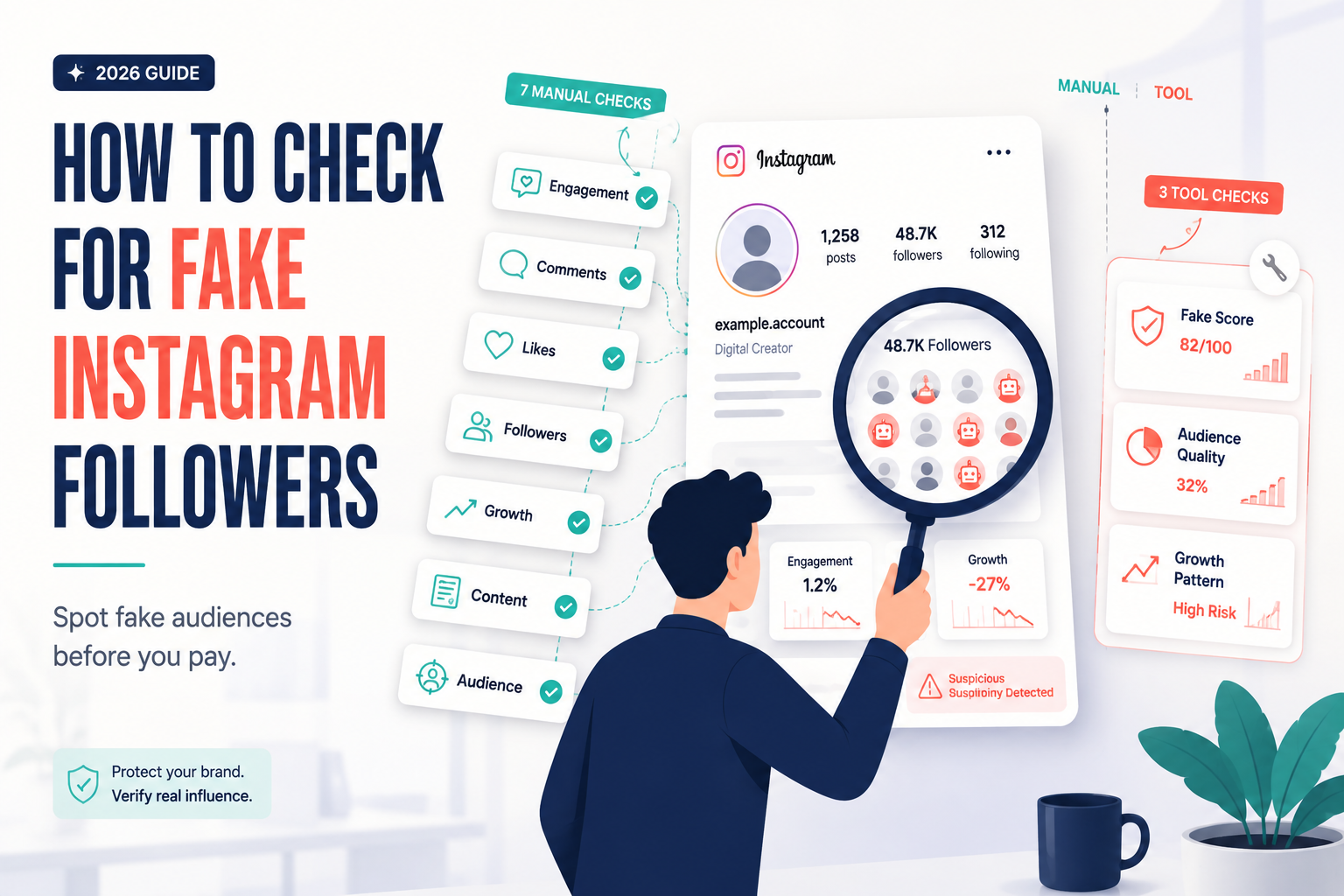
Check for fake Instagram followers with 7 manual signals, tool-based blind spots, and engagement benchmarks. Protect your budget before you sign the creator.
 Melissa Tan 陈慧敏1,921 words8 min read
In early 2026, a skincare brand found a 12,000-follower beauty creator. Engagement rate looked healthy at 3.1%, the comment section had plenty of activity. The brand paid $1,800 for one sponsored post. When the campaign data came in, reach was far below projections and conversions were nearly zero. A post-campaign audit revealed the creator had bought 4,000 fake followers. Her real 8,000 followers were genuinely engaged, but the fake accounts sat silent, which meant Instagram's algorithm tested the content on a batch that included those dead accounts, saw no interaction, and throttled distribution before the real followers ever saw it.
This scenario is avoidable. If the brand had run a vetting check before signing, the red flags would have shown up in 10 minutes. But most brands don't have a vetting process, or they only glance at engagement rate before signing. By the time the campaign data proves the problem, the money is gone.
The most common approach to vetting is "check the engagement rate," but that only catches the obvious cases. The expensive fakes are the ones that make engagement rate look normal, because a small group of real followers props up the numbers. To catch those, you need to compare engagement rate to tier benchmarks, find follower spikes with no viral post to explain them, and read the comment section for generic filler versus real conversation. Manual vetting can get you that far. After that, there are three blind spots — duplicate-comment rate, audience geography, and estimated suspicious-follower percentage — where you need a tool.
Key Takeaways
• Compare engagement rate to tier benchmarks, not a universal threshold. 0.9% is a red flag on a 20K account and normal on a 3M one.
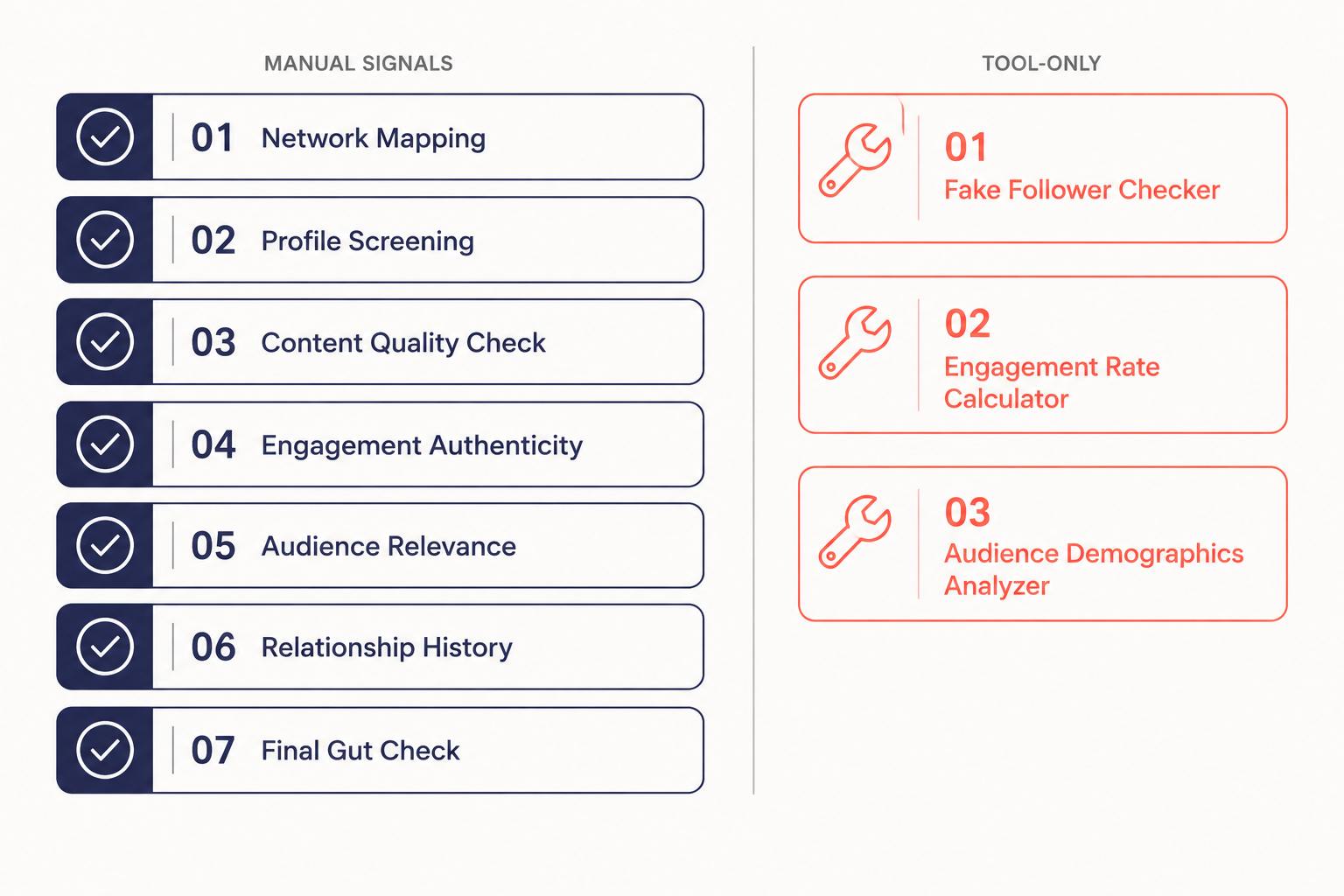
• Seven manual signals: engagement mismatch, growth spikes, generic comments, geography misalignment, follower/following ratio, identical engagement across posts, AI-generated profiles.
• Three tool-only checks: comment duplicate rate, meaningful-versus-generic breakdown, audience country/language distribution.
• 2026's fraud pattern pairs AI-generated headshots with engagement pods of real humans, so "empty profile" checks miss it.
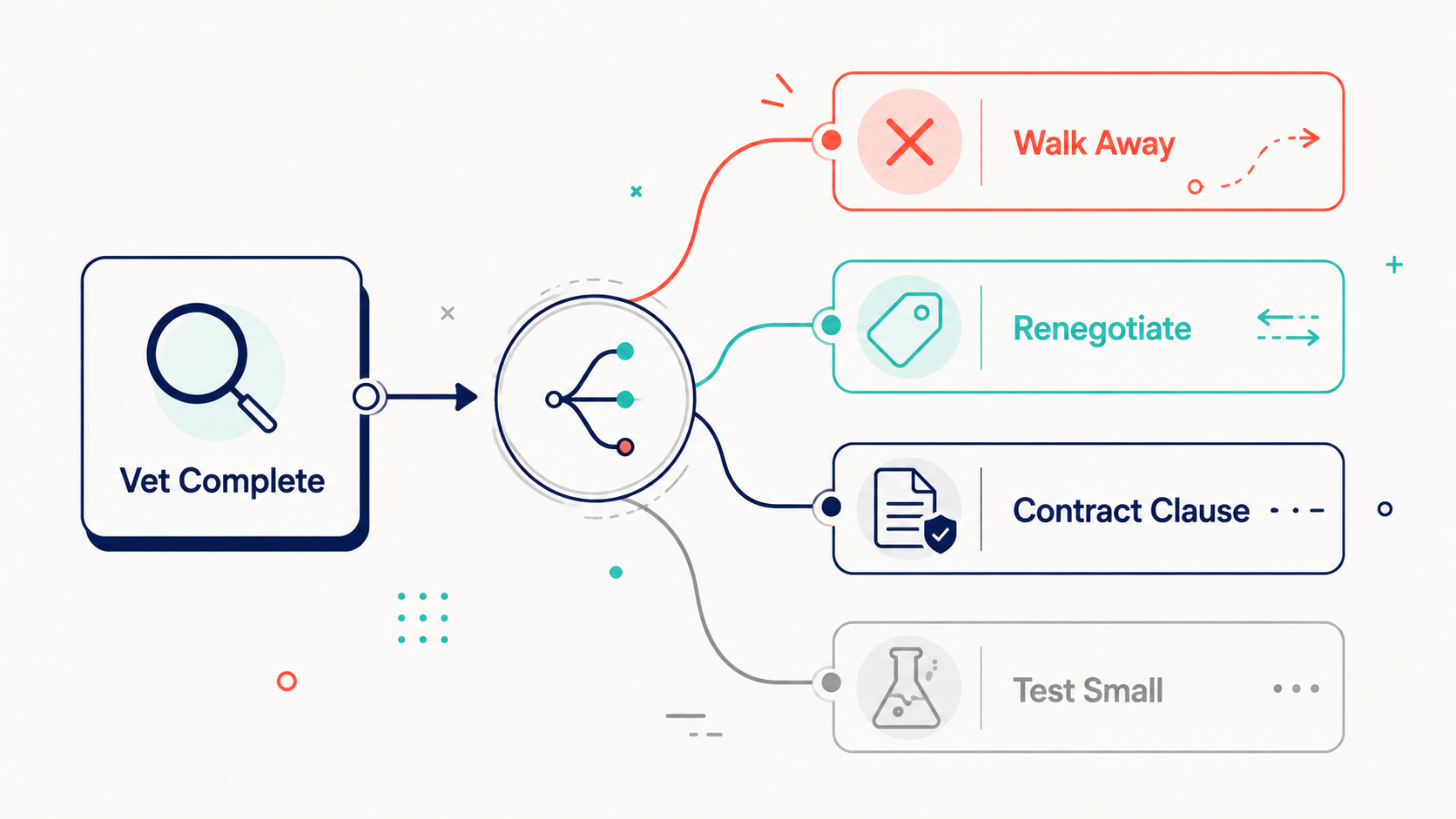
• When you find fakes: walk away, renegotiate with documented evidence, add a follower-quality clause, or test small first.
WFA's 2026 survey found 80%+ of marketing teams hit influencer fraud in the past 12 months, with the median mid-scale campaign losing $128,000 to inflated audiences. Here's how to stay out of that number.
Signal 1: Engagement Rate Doesn't Match Follower Tier
Engagement rate is (average likes + comments) ÷ follower count × 100, over the last 9 to 12 posts.
The threshold moves by tier:
- Nano (1K to 10K): 3.5 to 6%
- Micro (10K to 100K): 1.5 to 3.5%
- Mid (100K to 500K): 1.5 to 4%
- Macro and mega: 0.4 to 0.9%
A 50,000-follower account at 0.7% is under-benchmark. A 2 million-follower account at 0.7% is normal.
Two things distort this number. Formula: creators quote "engagement rate by reach" in media kits, which runs 3 to 4x higher than by-followers — recalculate from public data before comparing. Format: static posts average 1.2%, Reels average 3.8%, so a carousel-heavy account looks weak against a Reels benchmark even with a clean audience.
Full tier tables, the three competing formulas, and the cases where a low rate has nothing to do with fake followers: real Instagram followers benchmarks.
Red flag: under tier average and no legitimate explanation. Keep going.
Signal 2: Follower Growth Has Vertical Spikes
Check Social Blade or any follower-history tracker. Real viral growth forms a slope as a post circulates over days. Bought followers appear as a vertical line: +8,000 in one day, then flat.
The paired signal: a real viral moment spikes likes and comments at the same time as followers. Bought followers arrive with no engagement surge, because fake accounts follow but don't interact.
A 30,000-follower fitness account gained 5,200 followers on March 14, 2026. Their top post that week had 180 likes and 14 comments. A genuine 5,200-follower day would show 800+ likes minimum. That's a buy.
Caveat: follower trackers don't always capture hourly data, so a one-day spike could be compressed organic growth. Cross-check against content performance before concluding.
Signal 3: Comments Are Generic or Identical
Read the comments on the last 10 to 15 posts. Bot and pod comments are single emoji, generic filler ("Nice!", "Love this!"), random `user####` usernames, and no follow-up when the creator replies. Real comments reference specifics, ask questions, and turn into threads.
If 60%+ of comments are one-word generics with no thread, that's a red flag even when total engagement looks fine.
2026's version: AI-generated comments that reference the post specifically. "Your explanation of the serum layering order was so clear!" reads real until you notice 40 comments with the identical sentence structure. Look for template repetition, not just empty filler.
Signal 4: Audience Geography Doesn't Match Your Market
A US skincare brand found a creator with 80,000 followers and solid engagement. Audience location: 62% India, 18% Brazil, 9% Indonesia, 11% US.
That's not automatically fake — but it's a conversion mismatch, and fake-follower services source heavily from low-cost regions, so geography is both a fraud signal and a targeting problem.
Manual check: click into 20 random followers and note bio language and location tags. Limitation: this samples public accounts only and gives you a direction, not a percentage.
Signal 5: Follower-to-Following Ratio Is Imbalanced
A creator with 50,000 followers and 48,000 following is running follow-for-follow. Those users followed to get a follow-back, not because they care — conversion runs near zero.
Context matters: new accounts (under 6 months, under 5,000 followers) legitimately follow more while building. A 3-year-old account with 80,000 followers and 65,000 following is not organic growth.
Signal 6: Engagement Numbers Are Identical Across Posts
Check the last 20 posts. If every one lands within a few percent of the same like count — 4,200 / 4,180 / 4,210 / 4,195 — that's a pod or bought engagement.
Real audiences fluctuate wildly. One post hits 6,500, the next 3,200, a third goes semi-viral at 12,000. Algorithmic distribution is a slot machine. Paid engagement is a quota delivered every time.
Also check comment velocity: pod posts often get 80% of comments in the first 30 minutes, then silence. Organic comments spread over hours or days.
Signal 7: The 2026 AI-Profile Pattern
The old test was "empty profile: no posts, no bio, stock photo." That worked in 2023 and fails now. The current pattern uses AI-generated faces, plausible-interest bios, and 3 to 8 AI-generated grid posts to make the account look lived-in.
The tells: grid posts with 0 to 2 likes each, template bio phrasing, a professional-looking photo on an account with under 50 followers, created within 90 days.
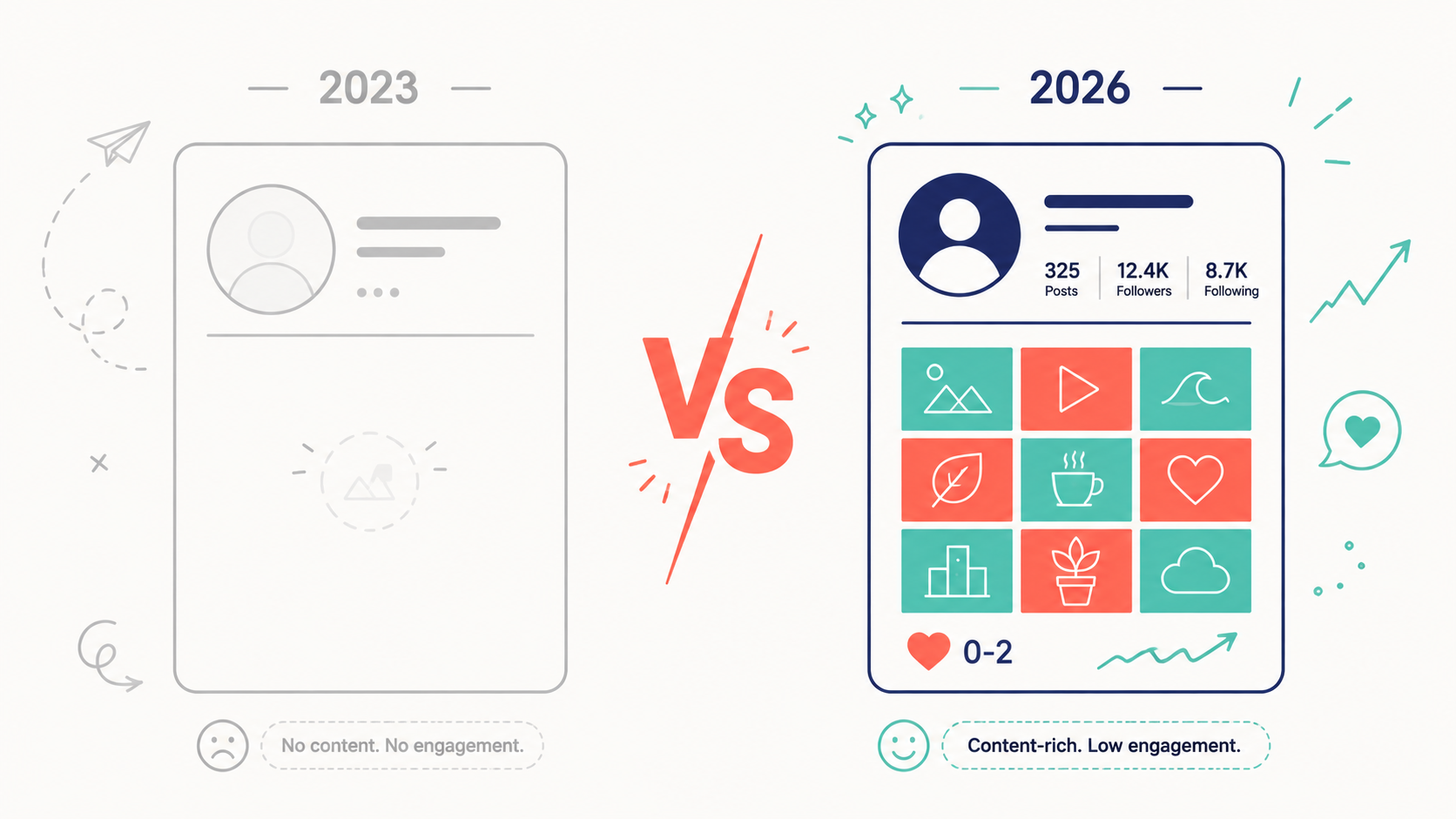
Click into 10 random followers. If 4+ match, the creator bought recently. Note that some of these accounts also join pods, so they do comment — the giveaway there is duplicate phrasing and 15 accounts hitting the same 6 creators at the same times.
What Manual Checking Can't See
You can calculate a rate, spot a spike, and read 50 comments. You cannot:
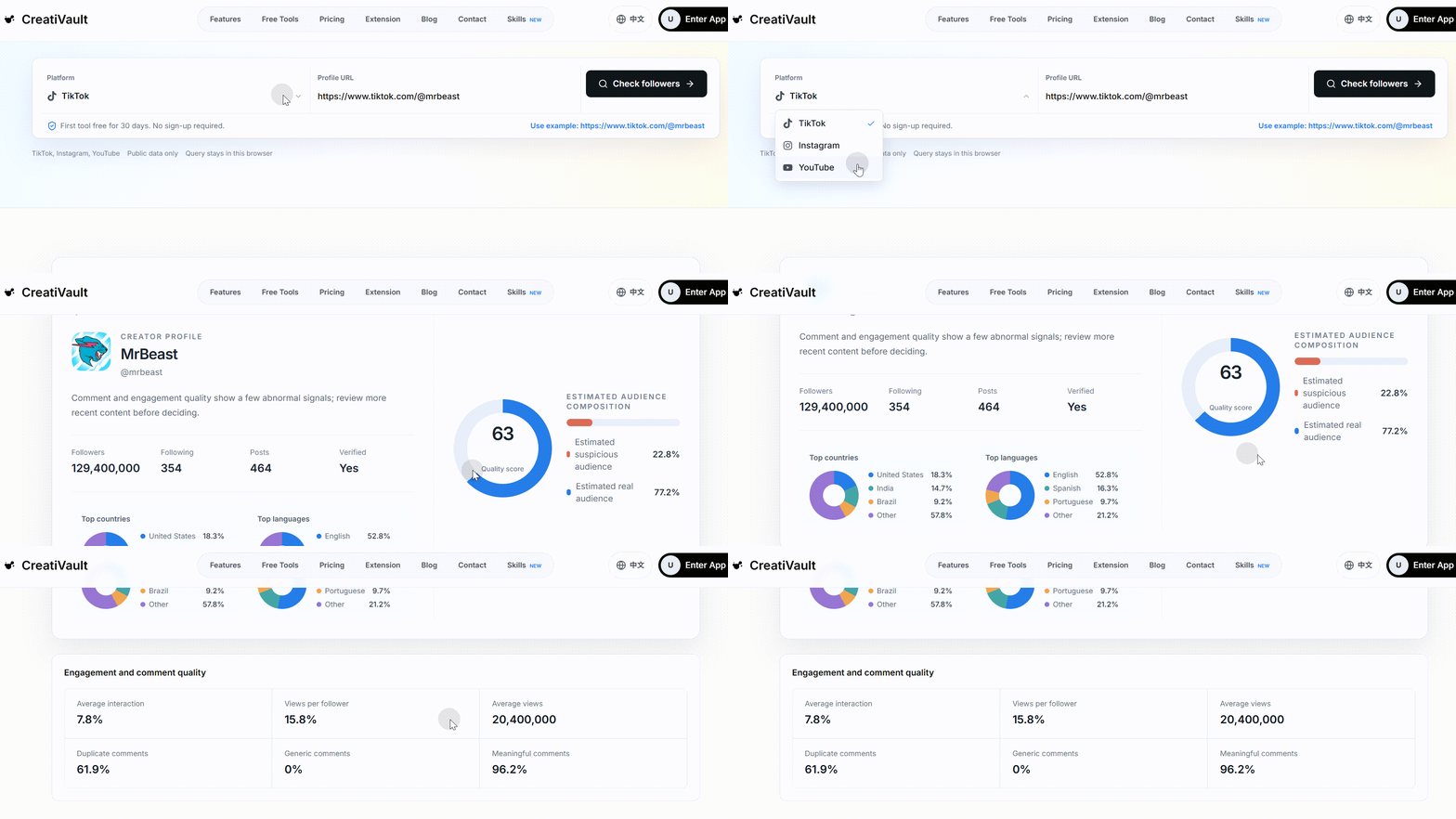
Quantify comment quality at scale. Reading 15 comments gives you a feel. Knowing 61.9% are duplicates and 96.2% are meaningful gives you a number you can defend to a client.
See audience country and language distribution. Twenty profiles is a sample. "18.3% US, 14.7% India, 52.8% English speakers" tells you whether the audience matches your market.
Calculate views per follower. A Reels creator with 100,000 followers should average 15,000+ views per Reel. At 4,000 views, either the audience is fake or Instagram isn't distributing them. Both are your problem.
The fake follower checker returns all three plus a 0-to-100 quality score and estimated real-versus-suspicious split.
Not every bad follower is fraud, and they don't cost you the same. Bots kill reach, ghosts just dilute it, inactive accounts only inflate the denominator — the bot vs ghost vs inactive breakdown covers which ones are deal-breakers and which are discount levers.
What to Do When You Find Fake Followers
The creator has 60,000 followers, 22% estimated suspicious, 1.1% engagement against a 2.5% tier average, half the comments pod-coordinated. Four moves:
Move | When to use it | What it gets you |
|---|---|---|
Walk away | 20%+ suspicious, or multiple signals fail | Cleanest outcome. Other creators exist |
Renegotiate | Audience is partly real and you want them | 60K with 22% fake = price them as a 47K creator |
Quality clause | You're committing to a multi-post deal | Shifts risk; makes creators clean up before signing |
Test small | Signals are mixed, not damning | $150 story before a $2,500 feed post |
Clause language that works: "Creator represents that fewer than 10% of followers are fake, bot, or inactive accounts as measured by [tool]. If a post-campaign audit shows otherwise, payout is reduced by [formula]."
Judge the Whole Pattern, Not One Signal
A single red flag means investigate. A creator at 2% engagement (fine for their tier) plus 70% generic comments plus a follower spike three weeks ago is a pattern — the rate looked fine because a small real audience carried it while most followers were fake.
Run all seven. Cross-reference against tool data. Compare within tier, format, and vertical.
When you're vetting more than a handful of creators, run the shortlist in CreatiVault to see engagement, audience composition, comment quality, and quality score side by side. The 20 minutes you spend checking saves the $2,800 you'd lose on a creator whose audience is 40% fake.
Frequently Asked Questions
Can you tell if someone bought Instagram followers?
Yes. Look for follower spikes with no viral post to explain them, engagement rate below tier average, generic or duplicate comments, and audience geography that doesn't match the creator's content language. Tools can quantify the suspicious-follower percentage and comment quality at scale.
What is a normal engagement rate on Instagram in 2026?
It depends on tier. Nano (1K-10K) averages 3.5-6%, micro (10K-100K) 1.5-3.5%, macro and mega 0.4-0.9%. Platform-wide engagement fell to 0.48% in Q1 2026, down 24% year-over-year, so older benchmarks read high. Format matters too: Reels average 3.8%, static posts 1.2%.
Does Instagram remove fake followers automatically?
Instagram runs periodic purges of bot and policy-violating accounts, which can cause follower drops. It doesn't catch everything, especially AI-generated profiles and pods made of real humans. Vet creators yourself rather than assuming the platform already cleaned the audience.
How do fake followers hurt a creator's reach?
Instagram shows each post to a small test segment first. If that segment is full of accounts that don't engage, the algorithm concludes the post isn't interesting and limits distribution — so real followers who would have engaged never see it. Lower organic reach means lower ROI for whoever paid for the post.
Can a creator have real followers and fake engagement?
Yes. Engagement pods are real people coordinating likes and comments to game the algorithm. Every account is real, but the engagement is purchased cooperation. Check for identical comment timing, duplicate phrasing across participants, and engagement that never converts to profile visits or link clicks.
 Sophie Klein