
Jul 29, 2026
Meta Ads Library: Complete Guide to Competitor Research (2026)
Learn how to use Meta Ads Library for competitor creative research. 2026 guide to searching ads, extracting insights, and building DTC creative strategy.
 Daniel Brennan3,751 words16 min read
The best-performing DTC brands don't guess what creative to test next — they systematically track what's already working for their competitors. Meta Ads Library is a free, public database showing every active ad on Facebook, Instagram, and Messenger from every advertiser worldwide. For cross-border DTC marketers, it's the single highest-leverage free tool for competitive creative intelligence.
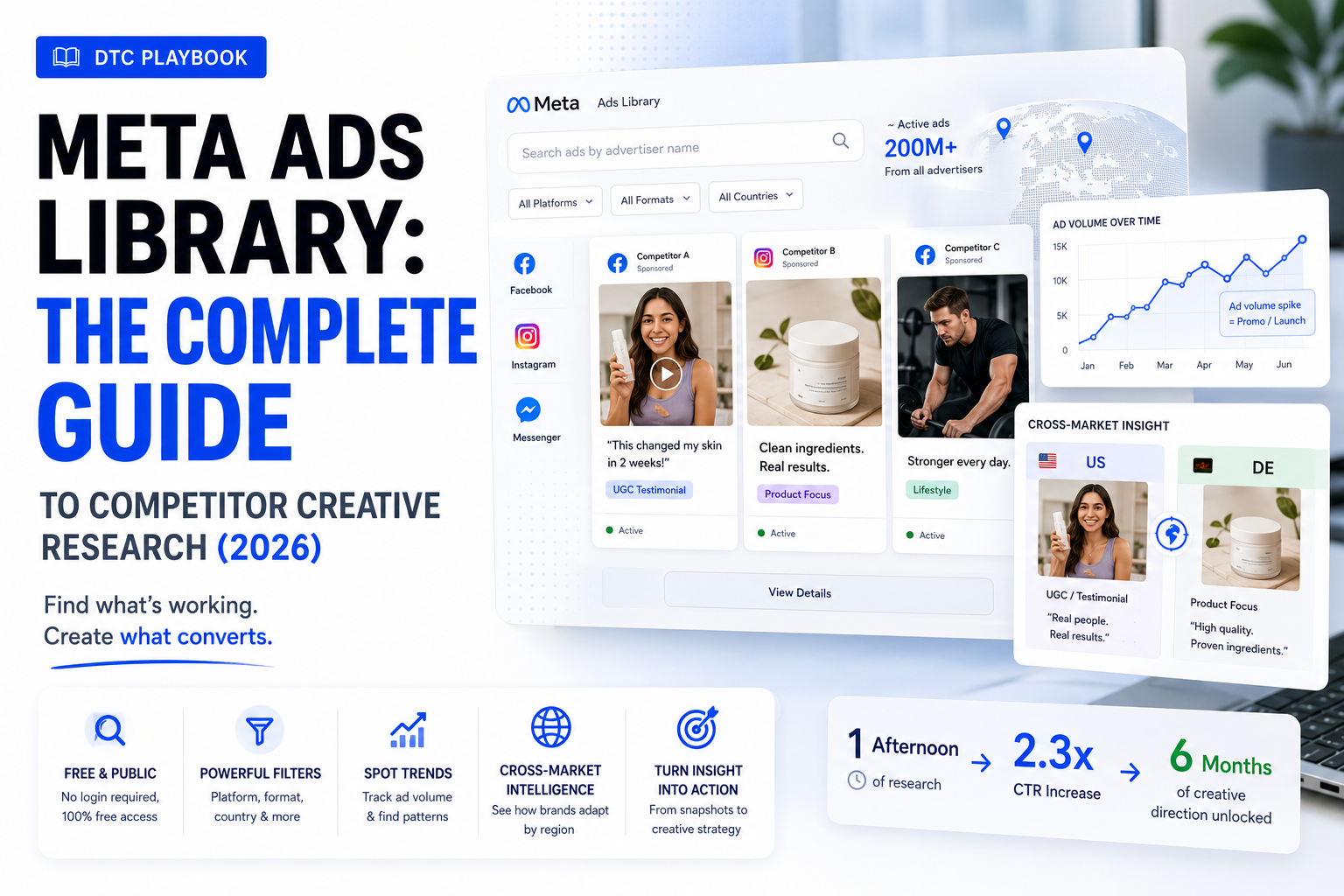
Last March, Marcus's supplement brand was stuck at $2M annual revenue. His creative felt stale, but he didn't know what to test next. He spent one afternoon in Meta Ads Library auditing his top 10 competitors. He discovered 8 out of 10 were running UGC-style testimonial videos, while he was still running product-only shots. He pivoted to UGC format. His CTR jumped 2.3x in three weeks. That one afternoon of research unlocked six months of creative testing direction.
This guide covers everything from basic searches to advanced cross-market creative intelligence workflows that turn competitor research into actionable creative strategy.
Key Takeaways
• Meta Ads Library is free and shows all active ads across Facebook, Instagram, and Messenger — no login required
• You can search by advertiser name, filter by platform, format, and country to analyze competitor creative strategies
• Advanced tactics include tracking ad volume trends to spot promotional cycles and launch patterns
• Cross-market filtering reveals how global brands adapt creative by region (US testimonials vs. German product-focus)
• Systematic workflows turn static competitor research into dynamic creative intelligence (from snapshots to marketing rhythm analysis)
What Is Meta Ads Library?
Meta Ads Library (formerly Facebook Ad Library) is Meta's public transparency tool launched in 2018. Originally created for political ad transparency, it expanded in 2019 to include all ads across Meta's platforms: Facebook, Instagram, Messenger, and Audience Network.
In 2026, it's evolved from a compliance tool into a strategic research asset. Every active ad from every advertiser is searchable, filterable, and visible to anyone — no account required.
What you CAN see:
- Ad creative (images, videos, carousel frames)
- Ad copy and headlines
- Call-to-action button type (Shop Now, Learn More, Sign Up)
- Platforms where the ad runs (Facebook, Instagram, etc.)
- Start date (when the ad became active)
- Active vs. inactive status
What you CANNOT see:
- Ad spend or budget
- Impressions, reach, or engagement
- Click-through rates or conversion data
- Audience targeting parameters
- A/B test variants (only what's currently live)
Despite these limitations, Meta Ads Library remains the most comprehensive free competitor research tool available. The absence of performance data is actually a feature — it forces you to develop pattern recognition skills rather than copying what competitors spend on.
How to Access Meta Ads Library
5 Steps to Start Using Meta Ads Library:
- Go to facebook.com/ads/library (no login required)
- Select "All ads" from the Ad category dropdown
- Choose your target country from the country selector
- Enter the competitor's Facebook Page name in the search bar
- Apply filters (platform, format, active status)
No Facebook account required for basic search. The interface is identical on mobile and desktop, though desktop offers better screenshot capabilities for building swipe files.
For DTC competitor research, keep "All ads" selected and use the country selector strategically when researching cross-border creative strategies.
Want to see how competitor creative intelligence works at scale? Explore automated multi-market tracking →
Basic Search & Filtering
Searching by Advertiser Name
Type the brand name exactly as it appears on their Facebook Page. Meta Ads Library matches against the Page name, not the business name.
Common search challenges:
- Brand variations (Nike vs. Nike.com vs. Nike Running)
- Multiple Pages for one brand (regional pages, product-specific pages)
- Name changes or rebrands
Pro tip: If you can't find a competitor, go to their Facebook Page first, note the exact Page name at the top, then search that in Ad Library.
Platform Filtering
After searching an advertiser, filter by where ads run:
- Messenger
- Audience Network
Most DTC brands concentrate on Facebook and Instagram. Checking platform distribution reveals strategic priorities — a brand running 80% of ads on Instagram signals a younger demographic focus or visual-first strategy.
Active vs. All Ads
Toggle between:
- Active — currently running right now
- All — includes recently paused ads (last 7 days for commercial ads, up to 7 years for political)
Why "All" matters: Inactive ads reveal creative tests that failed or campaigns that ended. If a competitor launched 15 video ads but only 3 are still active two weeks later, those 12 paused ads tell you what didn't work.
Ad Format Filtering
Filter by:
- Image (static single image)
- Video
- Carousel (swipeable multi-image/video)
- Collection (immersive mobile format)
Format analysis uncovers creative strategy shifts. When a brand suddenly shifts from 90% image to 70% video, something changed — either performance data, a new creative team, or a strategic pivot.
Advanced Search Tactics for DTC Marketers
Category-Level Research (Not Just Single Competitors)
Most marketers search one competitor at a time. Advanced researchers analyze entire categories.
How to do category-level research:
- Identify 15-20 competitors in your vertical
- Audit each in Ad Library, documenting active ad count, primary formats, and messaging themes
- Build a competitive creative database (spreadsheet, Notion, or Airtable)
- Look for patterns: What angles are saturated? What's underexplored?
This bird's-eye view reveals category norms and white space opportunities. If all 15 supplement brands use testimonial videos, that's either validation (testimonials work) or opportunity (stand out with a different angle).
Creative Angle Mapping
Beyond format, track creative angles:
- Testimonial/UGC — Real customers sharing results
- Product demo — Showing the product in use
- Lifestyle — Aspirational imagery without direct product focus
- Educational — How-to or explainer content
- Problem/solution — Pain point emphasis followed by product as solution
- Social proof — Reviews, ratings, media mentions
Build a taxonomy for your vertical. Over time, you'll spot which angles competitors rotate through and which they abandon quickly.
Tracking Creative Iterations Over Time
Revisiting Meta Ads Library every week to screenshot competitor ads is tedious. But the real loss isn't time — it's context. When you manually check ads, you see what's running, but you miss the rhythm.
The most sophisticated DTC teams track more than just "what creatives are live." They track:
- Ad volume trends: Did a competitor launch 12 new ads this week vs. 3 last week?
- Creative format shifts: When did they pivot from image to video?
- Campaign intensity cycles: Are they ramping up (new product launch?) or cooling down (end of promo)?
This is where automated creative intelligence platforms change the game. Tools like CreatiVault don't just monitor ads — they surface marketing dynamics. Instead of manually comparing screenshots from last Tuesday, you see a dashboard showing:
- Active ad count over time (spot promotional cycles)
- Creative type distribution shifts (detect format experiments)
- Cross-market launch sequencing (which market gets new creative first?)
Real example: A supplement brand noticed a competitor's active ad count jumped from 8 to 47 in one week, all video format. That signaled a major product launch. They adjusted their own launch timing to avoid direct collision. That insight came from tracking rhythm, not just ads.
Cross-Market Creative Research
If you're a cross-border DTC brand, this is one of the highest-leverage uses of Meta Ads Library: researching how competitors adapt creative by market.
Manual method:
- Go to Meta Ads Library
- Change country selector (top-right dropdown) to "United States"
- Search your competitor, document their active ads
- Repeat for UK, Germany, Australia, etc.
- Manually compare: What's different?
This works, but it's slow — and you're likely to miss subtle patterns unless you're systematically tracking.
Advanced approach: Cross-Market Creative Matrix
Build a creative strategy matrix across markets:
Real example: Sarah's fashion DTC brand was expanding from US to Germany. She used Meta Ads Library to research how global fashion brands adapted creative for German audiences. She noticed they used far less hype-y language and more product detail. German advertising regulations are stricter about health claims, and the audience expects more scientific specificity.
When she applied this insight — leading with product-focused creative instead of her US-style testimonial videos — her German conversion rate was 40% higher than her initial US-transplant creative. For more cross-border advertising best practices, including market-specific compliance and localization strategies.
Automation advantage for cross-market research:
If you're tracking 10+ competitors across 3+ markets, manual research becomes unscalable. This is where multi-dimensional filtering in creative intelligence platforms becomes critical.
For example, CreatiVault's filtering system lets you:
- Filter by Country + Active Status + Format simultaneously
- Instantly compare: "Show me all active video ads from Competitor X in Germany vs. their video ads in the US"
- Spot patterns: "This brand uses image ads in DACH region but video everywhere else — why?"
This type of cross-market strategy reconstruction is what separates basic competitor research from true creative intelligence. Learn more about creative intelligence frameworks for DTC brands.
What to Analyze When You Find Competitor Ads
Finding ads is easy. Extracting actionable insights requires a framework.
Creative Elements Checklist
For each competitor ad, document:
Visual style
- Color palette (bright and energetic vs. muted and premium)
- Composition (product-focused vs. lifestyle context)
- Talent (models, real customers, no people)
Hook (first 3 seconds for video, main headline for static)
- Question, statistic, bold claim, or scenario?
- Does it lead with problem or solution?
Messaging pillars
- What benefits are emphasized? (convenience, results, status, savings)
- What claims are made? (quantified results, social proof, guarantees)
- Tone: urgent, educational, aspirational, humorous?
Call-to-action
- Shop Now (direct purchase intent)
- Learn More (consideration stage)
- Sign Up (lead generation)
- Download (app install)
Format
- Static image, video (length?), carousel (how many frames?), collection
Strategic Questions to Ask
Don't just catalog ads. Interrogate them:
- Why might they be running this creative? (launch, promo, evergreen)
- What audience/intent does this target? (cold traffic, retargeting, lookalike)
- How does this fit their broader creative strategy? (new angle or recurring theme?)
- Is this a test or a proven winner? (new ad vs. running for weeks)
Building Your Swipe File
Organize competitor ads systematically:
Folder structure options:
- By competitor (Brand A, Brand B, Brand C)
- By creative angle (UGC, Product Demo, Testimonial)
- By format (Video, Image, Carousel)
- By campaign type (Launch, Promo, Evergreen)
Tools: Google Drive (free), Notion (flexible), Airtable (structured), or creative intelligence platforms like CreatiVault (automated).
The best swipe files aren't just repositories — they're filterable databases. Tag each ad with metadata (competitor, angle, format, date saved) so you can answer questions like "Show me all UGC videos from Q2 2026."
Systematic Competitive Creative Audit Workflow
Here's a proven process for turning Ad Library research into strategic intelligence:
Step 1: Identify 10-15 key competitors
Focus on direct competitors (same product category, similar price point, overlapping audience). Include 2-3 aspirational brands (where you want to be in 2 years).
Step 2: Initial Ad Library audit
For each competitor, document:
- Total active ad count
- Platform distribution (Facebook vs. Instagram split)
- Format breakdown (% image vs. video vs. carousel)
- Primary creative angles (testimonial, demo, lifestyle, etc.)
- Messaging themes
Step 3: Categorize by creative angle and format
Build a spreadsheet with columns: Competitor, Ad Format, Creative Angle, Messaging Theme, Screenshot Link, Date Captured.
Step 4: Identify patterns
- What angles are most common across competitors?
- What formats dominate?
- Are there seasonal trends? (More promo messaging in Q4?)
Step 5: Spot gaps
- What angles are underexplored?
- What formats are no one using?
- What messaging territories are unclaimed?
Step 6: Translate findings into creative hypotheses
"We noticed 8 out of 10 competitors use UGC testimonial videos, but none use expert/authority endorsement. Hypothesis: Expert angle is an untapped opportunity. Let's test."
Template: Competitive Creative Audit Spreadsheet
Turning Ad Library Research into Creative Strategy
Research without application is just data hoarding. Here's how to operationalize your findings.
From Competitor Ads to Creative Briefs
When you spot a pattern in competitor creative, don't copy — extract the strategic principle.
Wrong approach:
"Competitor X is running this exact video with this exact script. Let's make the same thing."
Right approach:
"Competitor X is running UGC testimonial format with before/after structure. Strategic principle: Social proof + visual proof resonates. Our version: UGC testimonials from our customers, highlighting our unique differentiator (ingredient purity, for example)."
Translate competitor research into creative briefs:
- Format to test: Based on what's prevalent (or underused)
- Creative angle: Testimonial, demo, lifestyle, educational
- Messaging pillar: What benefit/claim to emphasize
- Unique differentiator: How we stand out from category norms
Building Creative Testing Roadmaps
Prioritize angles based on:
- Competitor prevalence (if 80% of competitors use it, it probably works)
- Gap opportunity (if 0% use it, it's either genius or there's a reason)
- Brand fit (does this align with our positioning?)
- Production feasibility (can we execute this in 2 weeks or 2 months?)
Balance: Test what's working for others + test unique angles.
Sample testing roadmap:
Cross-Border Creative Localization
Use Ad Library to see how global brands adapt creative by market, then apply those principles.
US market creative norms:
- Fast-paced, hype-driven language
- Testimonials and UGC perform well
- Urgency and FOMO messaging common
German market creative norms:
- Detail-oriented, feature-focused
- Regulatory compliance for health/beauty claims
- Less hype, more substantiation
APAC market creative norms (varies by country):
- High production value expected
- Group/family benefits emphasized over individual
- Platform preference skews to Instagram, TikTok
When entering a new market, audit 5-10 successful local brands + 3-5 global brands operating in that market. Extract creative norms, then adapt your creative accordingly.
Limitations & Workarounds
Meta Ads Library is powerful, but it has constraints. Here's how to work around them.
No Performance Data
Ad Library shows what's running, not what's working. You see creative, but not CTR, CPA, or ROAS.
Proxy for performance: Ad longevity
Ads running 30+ days are more likely to be winners than ads paused after 1 week. Brands kill underperforming creative quickly. If an ad has been live for 60 days, it's probably delivering.
Workaround:
- Track ads over time. Note start dates. Revisit monthly.
- Ads that persist are worth studying more closely.
- Third-party tools (paid) estimate performance, but treat estimates skeptically.
No Audience Targeting Data
You see the ad, but not who it's shown to (age, gender, interests, behaviors, lookalike audiences).
Workaround:
Infer audience from creative and messaging.
- "New moms" creative angle → targeting parents with young children
- "Back to school sale" → targeting parents, students
- High-end product positioning → likely targeting higher income or purchase intent audiences
Manual Process Can Be Time-Intensive
Here's the reality: Auditing 10 competitors in Meta Ads Library takes 2-3 hours. You search each brand, filter through their ads, screenshot the relevant ones, organize them in folders, and repeat next week.
For agencies managing 5+ clients, that's 10-15 hours per week just on competitor research.
The case for automation:
There are two approaches to solving this:
1. Template-based manual workflows (free, but still slow)
- Use a standardized spreadsheet to log competitor ads
- Set a recurring calendar reminder for weekly audits
- Best for: Solo operators or single-brand teams
2. Automated creative monitoring (paid, but scales)
- Platforms like [CreatiVault](https://app.creativault.ai/growth/home?utm_source=creativault&utm_medium=blog&utm_campaign=28) continuously track your competitor list 24/7
- New ads from competitors are automatically captured, categorized by format and market
- You get a "Today's Competitor Creative Report" instead of spending 3 hours searching
- Best for: Agencies, multi-market DTC brands, high-frequency testing teams
ROI calculation: If your time is worth $100/hour and you spend 10 hours/week on manual research, that's $4,000/month in opportunity cost. Most automation tools cost $200-500/month.
Where automation wins hardest: Cross-border brands tracking the same 15 competitors across US, UK, Germany, and Australia markets. Manual search requires 4x the time (searching each market separately). Automated tools aggregate all markets into one dashboard.
Advanced: Integrating Ad Library with Creative Production
The highest-leverage teams don't just research — they integrate findings directly into creative workflows.
How Agencies Use Ad Library in Client Onboarding
Smart agencies deliver a Competitive Creative Audit as part of onboarding. It establishes expertise and provides a strategic foundation for creative recommendations.
Deliverable structure:
- Category landscape — Overview of top 10 competitors' creative strategies
- Format and angle analysis — What's saturated, what's underused
- Cross-market insights (for global clients) — How creative differs by region
- Recommended testing roadmap — Prioritized angles based on gap analysis
This positions the agency as strategic, not just execution-focused.
In-House Teams: Weekly Competitor Research Cadence
High-performing in-house creative teams run weekly competitor research sprints:
- Monday morning: 30-minute Ad Library review of top 5 competitors
- Document: New ads launched last week, format shifts, messaging changes
- Wednesday creative meeting: Present findings, propose new tests based on insights
- Friday: Kick off production for new creative angles
This rhythm ensures competitor intelligence continuously informs creative strategy.
Connecting Ad Library to Creative Briefs → Production → Testing
Workflow:
- Research (Ad Library) → Document competitor creative patterns
- Strategic translation → Extract principles, not copy creative
- Creative brief → Format, angle, messaging based on research
- Production → Execute brief
- Testing → Launch and measure performance
- Feedback loop → Compare your results to competitor prevalence (if everyone uses UGC and your UGC performs well, that's validation; if your UGC underperforms, investigate why)
Where creative intelligence platforms like CreatiVault add value:
Centralize competitor research + your ad performance in one dashboard. See competitor creative trends alongside your own testing results. Connect the dots: "Competitors shifted to video format in March. We tested video in April. Our video outperformed our image ads 2.1x. Insight validated."
Who Benefits Most from Systematic Ad Library Research?
Different roles extract different value from Meta Ads Library. Here's how each role should approach competitor creative intelligence:
For Media Buyers / Ad Operators
Your goal: Turn competitor ads into testable hypotheses for your own campaigns.
What to track:
- Which creative angles competitors are testing (testimonial, demo, UGC, lifestyle)
- Format mix (video vs. image vs. carousel — are they shifting?)
- CTA patterns (Shop Now vs. Learn More — what intent are they targeting?)
Workflow: Weekly competitor audit → Document new creative angles → Build testing roadmap: "Competitor X tested UGC format last week, let's test UGC this week and compare performance."
Automation value: With tools like CreatiVault, you get real-time creative change alerts. When a competitor launches 15 new video ads overnight, you know immediately — not when you happen to check next Tuesday. That's the difference between reactive and proactive testing.
For Brand Owners / DTC Founders
Your goal: Understand competitive marketing intensity and budget allocation signals.
What to track:
- Active ad count trends (Are competitors ramping up or cooling down?)
- Creative refresh frequency (High frequency = aggressive testing or new product push)
- Cross-market expansion patterns (Which markets are they entering next?)
Strategic insight: The Marketing Dynamics dashboard approach (tracking ad volume over time, not just individual ads) helps you answer:
- "Is my competitor doing a clearance sale (50+ ads suddenly) or a new product launch (new creative angles)?"
- "Are they pulling back ad spend (fewer active ads) or doubling down (more ads + more formats)?"
This isn't about copying their ads — it's about reading their strategic calendar so you can time your own launches, promos, and budget allocation. For more on DTC marketing strategy planning, see our comprehensive guide.
For Agencies / Creative Strategists
Your goal: Deliver competitive creative audits as a high-value client service.
What to track:
- Category-level creative trends (What are the top 10 brands in this vertical doing?)
- Creative angle saturation (Is everyone doing UGC? That's an opportunity to zig while they zag.)
- Format performance proxies (Long-running ads = likely winners)
Client deliverable: A quarterly "Competitive Creative Landscape Report" showing:
- Top 5 competitors' active creative strategies
- Emerging creative trends in the category
- Recommended angles for the client to test
Efficiency advantage: For agencies managing 10+ clients, manually researching competitors for each client is unsustainable. Centralized creative monitoring (like CreatiVault's multi-client dashboard) means you track 50+ brands once, then slice insights by client vertical.
Meta Ads Library FAQs
Is Meta Ads Library free?
Yes, completely free. No account required for basic search.
Do I need a Facebook account?
No for basic search. Yes if you want to see ads older than 7 days in some categories or access advanced filters (rare).
Can I see ads from any country?
Yes. Use the country selector dropdown to research ads running in US, UK, Germany, Australia, or 100+ other countries.
How far back does ad history go?
- Commercial ads: 7 days after they stop running
- Political/issue ads: Up to 7 years
- Active ads: As long as they remain active
Can I see how much competitors spend?
No. Meta Ads Library does not show spend, impressions, or any performance data. For spend estimates, you need third-party tools (paid), but estimates are often inaccurate.
Are there alternatives to Meta Ads Library?
Yes:
- TikTok Creative Center — TikTok ads (top-performing ads, not comprehensive)
- LinkedIn Ad Library — LinkedIn ads (limited search)
- Google Ads Transparency Center — Google/YouTube ads (political only in most regions)
- Creative intelligence platforms — CreatiVault, Foreplay, MagicBrief (aggregated multi-platform monitoring)
Meta Ads Library remains the most comprehensive free tool for Facebook and Instagram.
Conclusion
Meta Ads Library is the foundation of competitive creative intelligence for DTC brands. It shows you what's running, where it's running, and how competitors structure their creative strategies across markets.
But raw data isn't strategy. The brands that win don't just look at competitor ads — they extract patterns, track rhythm, and translate findings into testable creative hypotheses.
Three key principles:
- Track rhythm, not just ads — Ad volume trends reveal promotional cycles and launch intensity
- Go cross-market — Global brands adapt creative by region; learn from their localization strategies
- Build systems — One-off research is a snapshot; systematic tracking is strategic intelligence
Your next steps:
- Identify your top 5 competitors
- Audit their active ads in Meta Ads Library this week
- Document format, angle, and messaging patterns
- Build one creative hypothesis to test based on what you found
For brands tracking 10+ competitors across multiple markets, manual research becomes a bottleneck. That's when automation delivers ROI. [See how CreatiVault turns Ad Library research into actionable creative intelligence →](https://app.creativault.ai/growth/home?utm_source=creativault&utm_medium=blog&utm_campaign=28)
The best creative doesn't come from guessing. It comes from knowing what's already working — and finding the angles no one else has tested yet.
---