Jul 30, 2026
How to Find Influencers on Amazon: 6 Methods That Work
Learn how to find influencers on Amazon. There's no public directory, so use social bios, Google site-search, Amazon Live, and storefront vetting. Start now.
 Daniel Brennan2,416 words10 min read
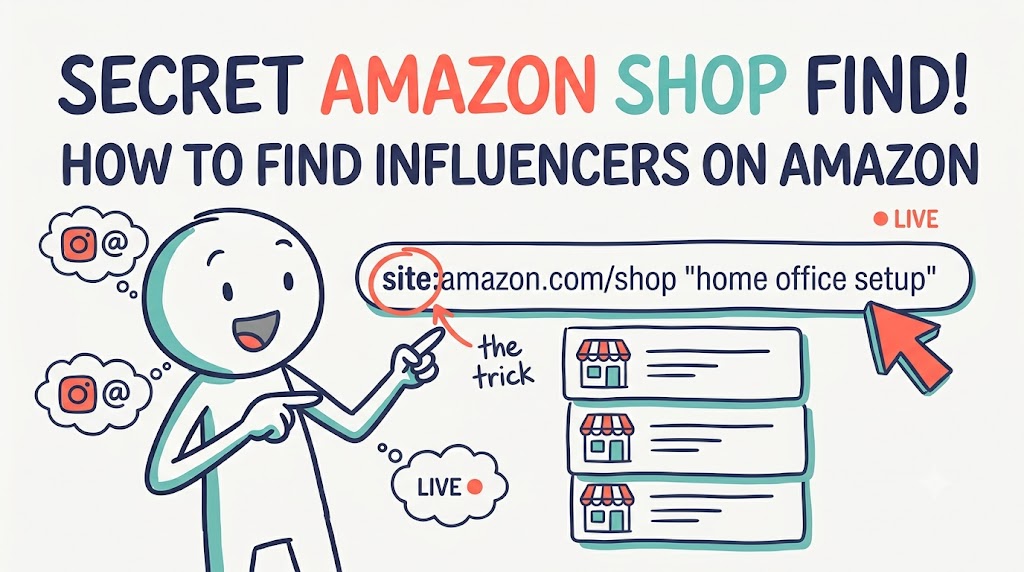
To find influencers on Amazon, don't search Amazon. There's no public directory of Amazon influencers, so you find them where they promote their storefronts: in social media bios, through the Google operator site:amazon.com/shop "your niche", on Amazon Live, and via the #FoundItOnAmazon feed. Then you check their storefront and vet them before reaching out.
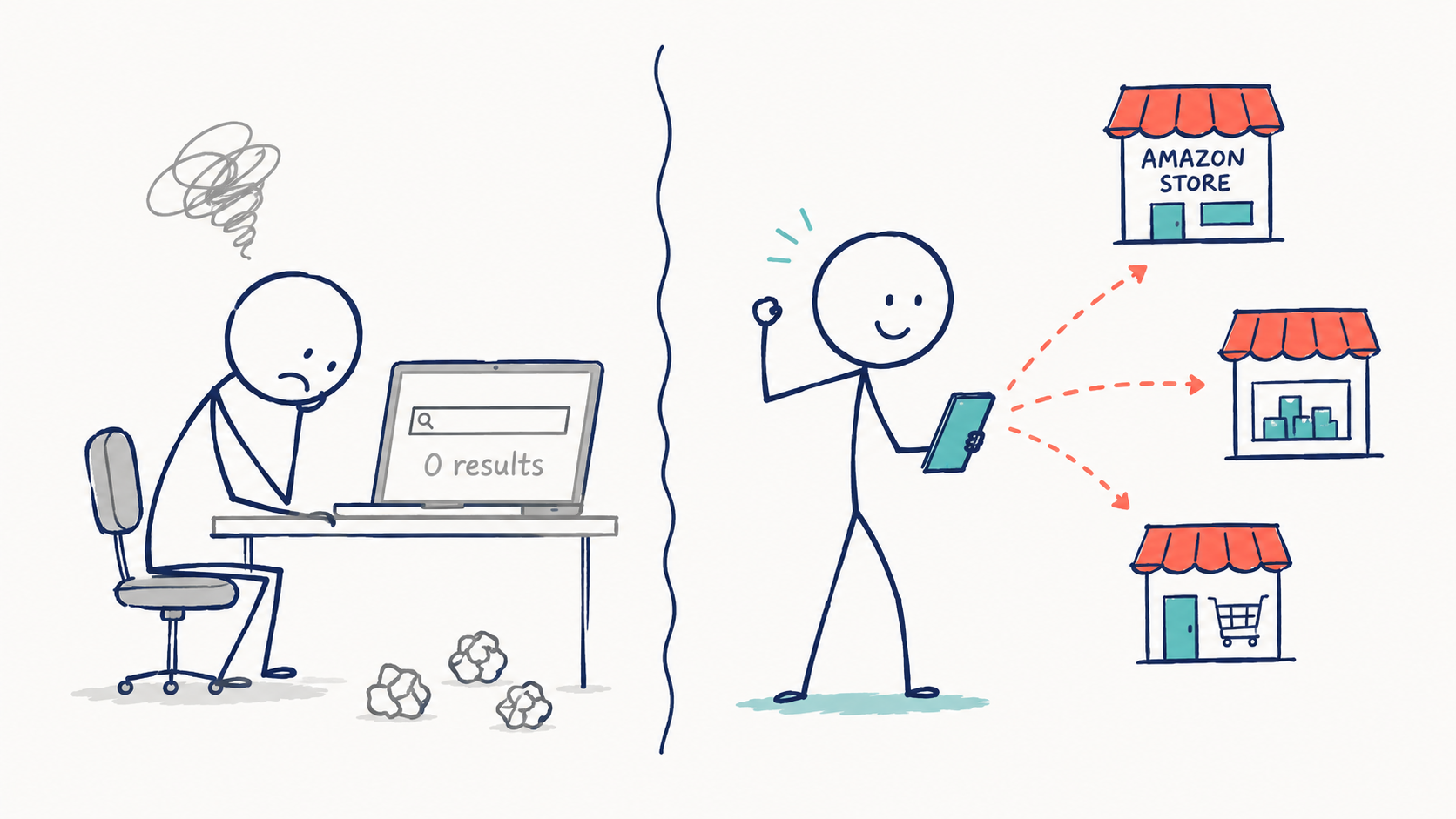
That first fact trips up almost every seller. When Daniel, a DTC kitchenware brand owner, decided to run an Amazon creator campaign in early 2026, he spent an entire afternoon typing creator names into Amazon's search bar and coming up empty. Amazon doesn't index its influencers that way. Once he switched to a Google site-search operator, he built a list of 40 relevant storefronts in under an hour.
This guide gives you the six methods that actually surface Amazon influencers, the trick to check any creator's storefront in seconds, and the vetting checklist that keeps you from paying for the wrong partner.
Key Takeaways
- Amazon has no public influencer directory, you find creators through social platforms and Google, not on Amazon itself
- The fastest free method is the Google operator site:amazon.com/shop "your niche"
- Check any creator's storefront instantly with amazon.com/shop/@theirhandle
- Amazon influencers drive external traffic that lifts your Best Sellers Rank, not just direct sales
- Vet by category fit and storefront recency, not follower count
Amazon Affiliate vs Amazon Influencer: What's the Difference?
An Amazon affiliate earns commission by sharing product links anywhere online. An Amazon influencer gets a curated storefront at amazon.com/shop/theirname plus the ability to livestream, and must qualify with an established social following. Every Amazon influencer is an affiliate, but not every affiliate is an influencer.
The distinction matters when you're deciding who to partner with.
Amazon Associates (Affiliate) | Amazon Influencer Program | |
|---|---|---|
Who qualifies | Anyone with a website or blog | Creators with an established social following |
What they get | Trackable product links | A storefront page, plus Amazon Live access |
Where they promote | Blogs, newsletters, review sites | Instagram, TikTok, YouTube, Amazon Live |
Best for brands who want | Written reviews and SEO content placement | Video demos and social-driven traffic |
For most cross-border DTC brands, the influencer side is where the leverage is. A blog affiliate places your product in an article that may take months to rank. An influencer with a storefront can demo your product on video this week, and their audience arrives at Amazon already convinced.
That said, don't dismiss affiliates entirely. If your product needs explanation, a detailed written review from an affiliate with an established review site can convert better than a fifteen-second video.
How the Amazon Influencer Program Works
The Amazon Influencer Program lets approved creators build a personal storefront at amazon.com/shop/theirname, where they curate products and earn commission on sales driven through their links. Amazon does not publish a list of program members, and its on-site search will not surface them by name or niche.
Two things make this different from regular influencer marketing.
First, there's no searchable directory. This is why searching Amazon directly feels like hitting a wall, and why every method below starts somewhere other than Amazon's search bar.
Second, the real value is external traffic. When an Amazon influencer promotes your product to their off-platform audience, that outside traffic signals demand to Amazon's algorithm, which can lift your Best Sellers Rank. For cross-border DTC brands, that ranking bump is often worth more than the direct commission sales.
There's a strategic reason this matters more on Amazon than anywhere else. Amazon shoppers arrive with intent to buy, so conversion rates on well-matched creator traffic tend to run far higher than typical social commerce. A creator who sends a warm, pre-sold audience to your listing does double duty: they drive the sale, and the resulting sales velocity pushes your product up the rankings. Get the match right, and one good creator can move the needle on an entire product line.
So the goal isn't just "find a creator." It's find a creator whose audience will click through from social media to Amazon and buy.
How to Find Influencers on Amazon: 6 Methods
The six ways to find influencers on Amazon are: crawling social media bios, the Google site-search operator, the #FoundItOnAmazon hashtag, Amazon Live browsing, reverse product search, and paid discovery tools. Start with the Google operator, it's free and returns results in seconds.
Method | Cost | Best For | Speed |
|---|---|---|---|
Social bio crawl | Free | Reusing an existing influencer list | Medium |
Google site-search | Free | Finding creators by niche fast | Fast |
#FoundItOnAmazon feed | Free | Spotting active, product-focused creators | Medium |
Amazon Live | Free | Finding proven on-camera sellers | Medium |
Reverse product search | Free | Warm, category-relevant outreach | Slow |
Discovery tool | Paid | Scaling past 20–30 creators | Fast |
1. Crawl Social Media Bios
Most Amazon influencers link their storefront in their Instagram, TikTok, or YouTube bio, often through a Linktree or a direct amazon.com/shop link. Browse creators in your niche on those platforms and check their bios and link hubs.
This works because creators want traffic to their storefront. They advertise it where their audience already is. If you've already built an influencer list on Instagram, you're halfway done, just check each bio for the Amazon link.
2. Use the Google Site-Search Operator
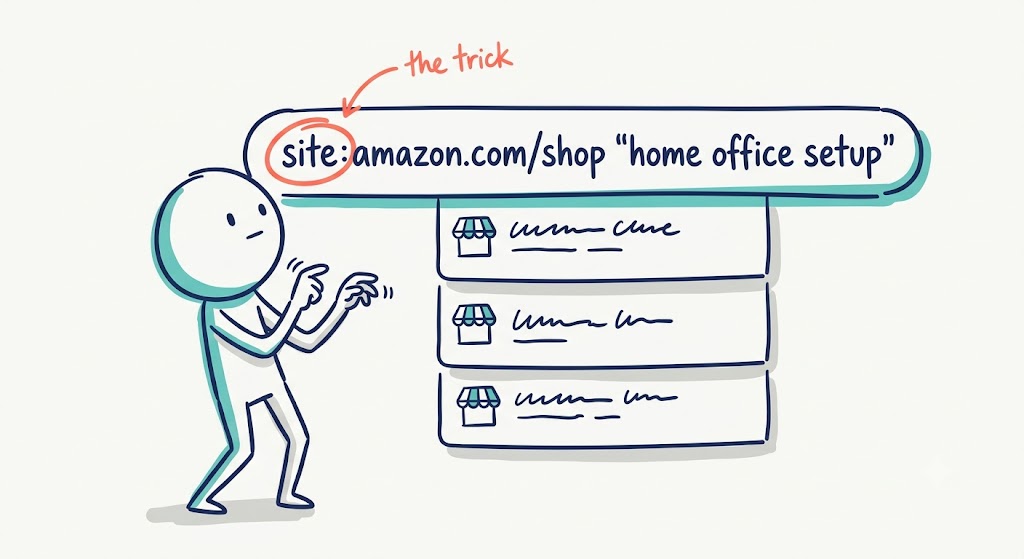
This is the single fastest way to find an influencer on Amazon in a specific niche. Type this into Google:
site:amazon.com/shop "your niche keyword"
For example:
- site:amazon.com/shop "home office setup"
- site:amazon.com/shop "skincare routine"
- site:amazon.com/shop "capsule wardrobe"
Google has indexed public storefronts, so this returns real Amazon influencer pages matching your niche. Copy the operator, swap in your keyword, and build your list. This is exactly the trick that saved Daniel his wasted afternoon.
Building a big list fast? Once you've got 40 storefronts, the bottleneck becomes tracking and outreach, not discovery. CreatiVault's Influencer Scout lets you organize candidates and manage outreach in one pipeline instead of a messy spreadsheet. See how it works →
3. Search #FoundItOnAmazon and the Amazon Finds Feed
Amazon influencers tag their content with #FoundItOnAmazon across social platforms. Search that hashtag on Instagram or TikTok to surface active creators showing off Amazon products.
You can also browse the Amazon Finds feed directly at amazon.com/foundit, a shoppable feed of creator content organized by category. There's no search box, so you scroll and filter by category, but every creator you see is an active program member.
4. Browse Amazon Live
Amazon Live (amazon.com/live) is Amazon's live-streaming shopping feature. Creators stream product demos in real time, and the Browse tab lets you filter streams by category.
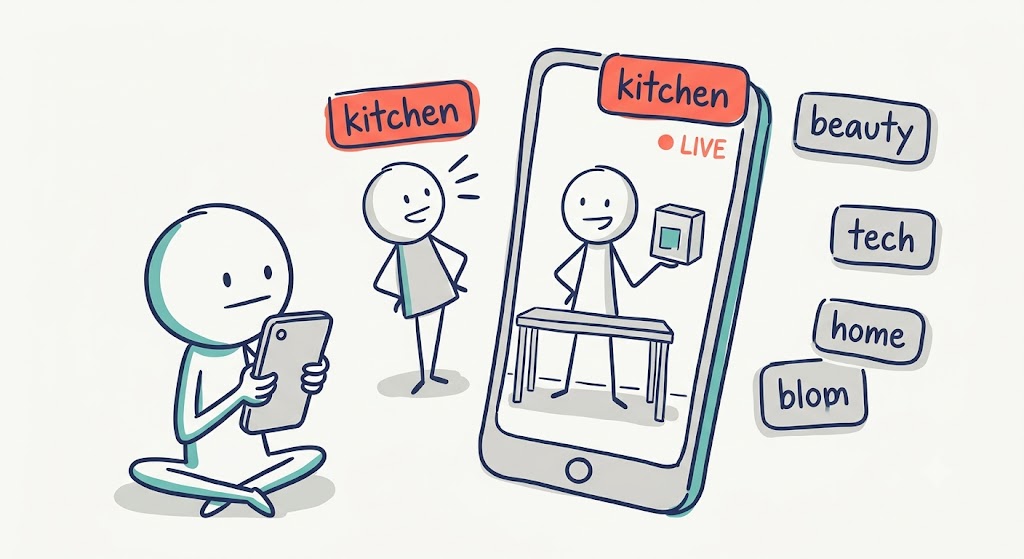
This method is gold for finding creators who are already comfortable selling on camera. If a creator is livestreaming in your product category, they've been vetted by Amazon and they know how to convert. Watch a few minutes of their stream to judge fit before reaching out.
5. Reverse Product Search
Find products similar to yours on Amazon, then scroll to the Product Videos or related content section on the listing. Creators who reviewed or demoed those products are often program members already working in your category.
This method finds creators with proven interest in products like yours, which usually means warmer, more relevant outreach.
6. Use a Discovery Tool When Manual Stops Scaling
Free methods work for your first 20 or 30 creators. Past that, manual crawling eats hours. Purpose-built platforms let you filter creators by Amazon selling category, social stats, and audience, then export contact details.
Think of it this way: free methods prove the channel works, tools scale it once you know it does. Don't pay for a tool before you've validated the channel with a few manual campaigns.
How to Find Influencer Storefronts on Amazon by Name
To find influencer storefronts on Amazon for a specific creator, type amazon.com/shop/@theirhandle into your browser, swapping in their social handle. If they're in the program, their storefront loads instantly. If you get a 404, check their bio and Linktree, many creators use a custom URL rather than their handle.
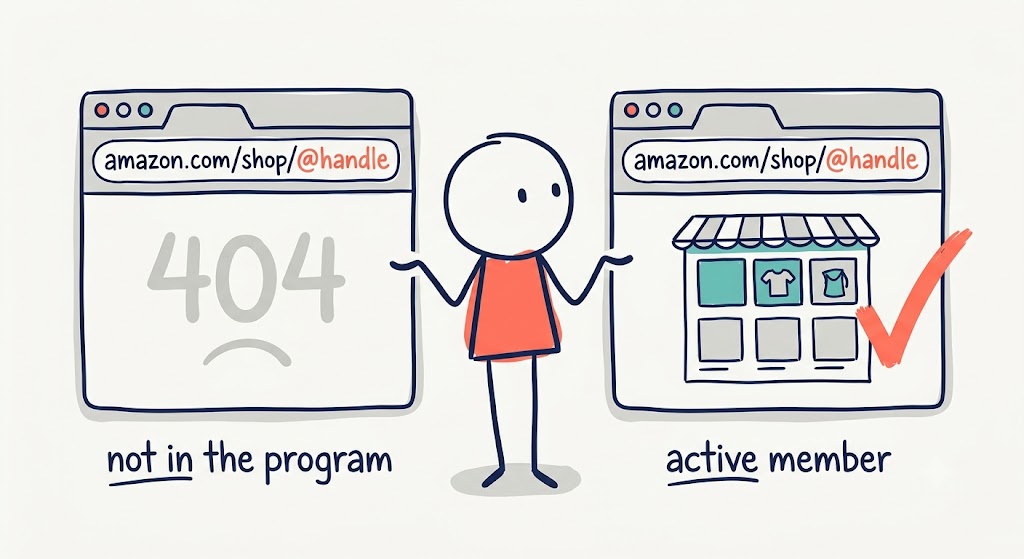
This is the bridge between platforms. You find creators on Instagram or TikTok using the methods in our guide on how to find Instagram influencers, then confirm their Amazon presence in one step.
How to Find Influencers You Follow on Amazon
If you want to check which creators you already follow on social media have Amazon storefronts, work through your following list and run each handle through the amazon.com/shop/@handle check. It's tedious manually, but it's the fastest way to convert an existing list of creators you already trust into a list of Amazon partnership candidates.
For brands, this is often the highest-converting starting point. You already know these creators produce good content and have engaged audiences. Confirming their Amazon presence turns a warm list into an actionable one.
How to Vet an Amazon Influencer Before You Reach Out
Vet an Amazon influencer on four criteria: category fit with your product, storefront activity within the last 30 days, genuine social engagement, and audience geography matching your selling markets. Follower count is the weakest signal of the five.
Finding a storefront is easy. Making sure it's the right one takes a quick check. Run every candidate through this before you send an outreach message.
Category and Product Fit
Open their storefront and scan the inventory. Does your product type match a meaningful share of what they already promote? A creator whose storefront is 70% kitchen gadgets is a strong fit for a cookware brand, and a poor fit for a skincare line. Alignment beats reach.
Storefront Recency
Check when they last updated. An active influencer refreshes Idea Lists, adds photos and videos, or streams on Amazon Live within the last 30 days. A storefront that's been dormant for six months won't drive traffic no matter how many followers the creator has.
Engagement and Audience Quality
Look at their social engagement rate, not just follower count. Watch for real comments versus bot signals, and check that their audience lives in the markets where you sell. For cross-border brands, audience geography is critical, a creator with a US storefront but a mostly non-US audience won't convert for a US launch.
Disclosure and Brand Safety
Confirm they disclose sponsorships properly and quickly Google their name for any controversies. One brand-safety issue can undo a campaign.
The Full Vetting Checklist
Before outreach, confirm:
- Product category matches a meaningful share of their storefront
- Storefront updated within the last 30 days
- Social engagement rate is healthy for their tier
- Audience geography matches your selling markets
- Sponsorships are clearly disclosed, no brand-safety red flags
Turn Amazon Creator Discovery into a Repeatable System
Finding one Amazon influencer is a task. Running creator campaigns every month is a system, and that's where most brands stumble.
When Mei, a marketer at a cross-border home goods brand, ran her first Amazon creator push in 2026, she tracked everything in a spreadsheet. By the third campaign she was re-contacting creators she'd already talked to and losing track of who was negotiating. She moved the whole pipeline into a dedicated tool and cut her admin time in half.
The workflow is simple: build a shortlist, unlock contact details, send outreach, then track each creator through the pipeline, contacted, replied, negotiating, signed. This is the full loop Influencer Scout is built for, and it pairs naturally with CreatiVault's Products feature when you're researching which Amazon products are actually selling. Ready to run your Amazon creator pipeline in one place? Explore CreatiVault's features →
Frequently Asked Questions
Is there a directory of Amazon influencers?
No. Amazon does not publish a public directory of Influencer Program members, and its on-site search won't surface them by niche. You find Amazon influencers through social media bios, the Google operator site:amazon.com/shop "niche", Amazon Live, and the #FoundItOnAmazon feed.
How do I find influencers on Amazon in my niche?
The fastest way is the Google site-search operator: site:amazon.com/shop "your niche keyword". It returns indexed storefronts matching your niche. You can also browse the Amazon Finds feed by category or filter Amazon Live streams by category.
How do I find an influencer's Amazon storefront?
Type amazon.com/shop/@theirhandle into your browser, using their social media handle. If they're in the program, their storefront loads. If that doesn't work, check their Instagram, TikTok, or YouTube bio for a storefront or Linktree link.
What's the difference between an Amazon affiliate and an Amazon influencer?
An Amazon affiliate earns commission by sharing product links anywhere online and needs only a website or blog to qualify. An Amazon influencer gets a curated storefront plus Amazon Live access, and must have an established social following. For brands wanting video demos and social traffic, the influencer side is usually the better fit.
How many followers do you need for the Amazon Influencer Program?
Amazon doesn't publish a hard follower minimum. Approval depends on follower count, engagement rate, and content quality together, and creators with a few thousand highly engaged followers are sometimes approved while larger accounts with weak engagement are not.
Can I use Amazon Live to find influencers?
Yes. Visit amazon.com/live and use the Browse tab to filter live streams by category. Every streamer is an active program member, and watching a few minutes shows you how well they sell on camera before you reach out.
Finding Amazon Influencers Starts with One Shift
You now have six ways to find influencers on Amazon, from crawling social bios to Google site-search to Amazon Live. But the real unlock is the mindset shift: stop searching Amazon, start searching where creators advertise their storefronts.
There's no directory, so social bios, the site:amazon.com/shop operator, and the amazon.com/shop/@handle check are your fastest paths in. Once you have a list, vet each creator by category fit and storefront recency, not follower count, then track your outreach in a system that scales past the spreadsheet.
Here's your next step: pick one method, the Google operator is the quickest, and build a list of 10 Amazon influencers in your niche today. Run each through the vetting checklist, and you'll know exactly who's worth an outreach message. That's how you find influencers on Amazon who actually move product.
 Sophie Klein