Jul 29, 2026
7 Best Micro Influencer Platforms in 2026: Cost, ROI & Database Comparison
Compare 7 top micro influencer platforms for finding creators with 10K-100K followers. Real costs, engagement rates, and ROI data for DTC brands.
 Sophie Klein4,028 words17 min read
The best micro influencer platforms in 2026 are Modash, CreatiVault, Aspire, HypeAuditor, Upfluence, Grin, and Collabstr — each optimized for finding creators with 10K-100K followers at a fraction of celebrity influencer costs.
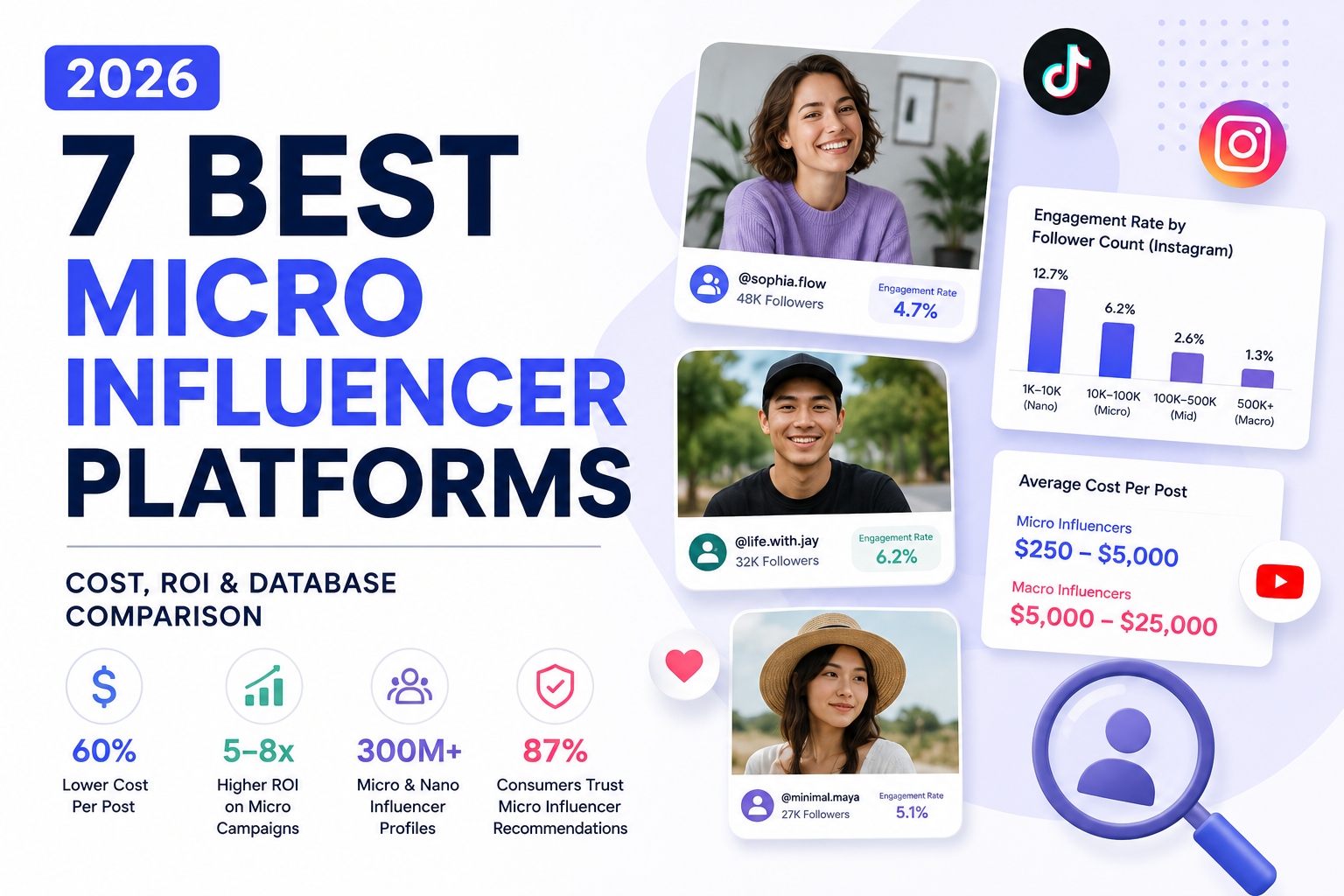
Micro influencers deliver 2x the engagement rates of macro influencers (2.6% vs 1.3% on Instagram) at 60% lower cost per post. But most influencer platforms were built for celebrity partnerships and struggle to surface nano and micro creators who aren't already on agency rosters.
Here's what separates the seven platforms below: database depth in the 10K-100K follower range, search filters for niche audiences, transparent pricing for small teams, and whether the platform lets you discover creators or requires them to apply to you. We analyzed database sizes, pricing models, user reviews, and ROI benchmarks to show you which micro influencer platform fits your budget and workflow.
What you'll learn:
- Why micro influencers generate 5-8x ROI while macro campaigns average 3-5x
- Which platforms have the deepest nano/micro databases (300M+ profiles vs 10M matters)
- Real cost breakdowns: $250-5,000 per post for micro vs $5,000-25,000 for macro
- How engagement drops from 12.7% (nano TikTok) to 1.3% (macro Instagram) as follower count rises
Key Takeaways
• Modash has the largest micro influencer database at 300M+ profiles including all creators with 1K+ followers, priced at $199-499/month with transparent plans
• Micro influencers cost 60% less per post ($250-5,000) than macro influencers ($5,000-25,000) while delivering 2x higher engagement rates
• ROI averages 5-8x for micro campaigns vs 3-5x for macro, with top micro campaigns returning $11-28 per dollar spent
• 87% of consumers trust micro influencer recommendations vs 31% trusting celebrity ads, driving 20% higher conversion rates
• CreatiVault combines micro influencer discovery with ad intelligence, helping DTC teams validate which creators align with winning ad creatives
Why Micro Influencers Outperform Macro and Celebrity Tiers
The data is clear: smaller creators generate better results for most DTC brands.
According to Jem Social's 2026 analysis, Instagram micro influencers average 2.6% engagement while macro influencers drop to 1.3% — that's a 2x difference. On TikTok, nano influencers hit 12.7% engagement, peaking at 17.4% in food and parenting niches.
The cost gap is even more dramatic. Micro creators charge $250-5,000 per Instagram post with a cost per engagement around $0.20. Macro influencers charge $5,000-25,000 at $0.33 per engagement. You're paying 60% less per post and getting 2x the engagement.
ROI follows the same pattern. Micro campaigns return 5-8x ROI on average, while macro campaigns deliver 3-5x. Top micro campaigns can hit $11-28 per dollar spent. One case study tracked 211 micro creators generating 13:1 ROI and a 4.7x monthly sales lift on Amazon.
Trust drives the difference. Edelman's research shows 87% of consumers trust micro influencer recommendations, compared to just 31% trusting celebrity ads. Nielsen found 94% of consumers aged 18-44 trust influencer-generated content over brand ads.
The Problem Most Platforms Don't Solve
Enterprise influencer platforms like GRIN, CreatorIQ, and Traackr were built for Fortune 500 brands managing celebrity partnerships. Their databases prioritize macro influencers with existing agency representation. Search filters assume you're looking for verified accounts with 100K+ followers.
When you filter for 10K-50K followers in a specific niche — say, sustainable fashion micro influencers in Germany — these platforms return thin results or nothing at all.
The seven micro influencer platforms below solve this by crawling public data across all creator tiers, offering transparent pricing for small teams, and building search tools that surface niche creators who've never worked with brands before.
Want to see how micro influencer discovery works? CreatiVault's Influencer Scout lets you filter by follower range, engagement rate, niche, and location to build shortlists of micro creators in minutes.
What to Look for in a Micro Influencer Platform
A good micro influencer platform needs three capabilities: deep database coverage in the 10K-100K range, filters that let you drill into niche audiences, and pricing that doesn't require a six-figure annual contract.
Core features that matter:
- Database depth: Does the platform include all creators with 1K+ followers, or only those who've opted in?
- Search granularity: Can you filter by engagement rate, audience demographics, location, and content category simultaneously?
- Discovery vs marketplace: Do you search for creators, or do they apply to you?
- Pricing transparency: Can you see costs upfront, or do you need a demo and custom quote?
- Campaign workflow: Does the platform handle outreach, content approval, and payment tracking, or just discovery?
Most platforms split into two models: all-in-one suites that manage discovery through payment, and specialist tools that excel at finding micro creators but require you to handle outreach externally.
1. Modash — Best for Largest Micro Influencer Database and Transparent Pricing
Pricing: $199/month (Essentials) to $499/month (Performance) | Contract: Monthly or annual | Free Trial: 14 days, no credit card required
What Modash Does Well
Modash has the largest micro influencer database on the market: 300M+ profiles across Instagram, TikTok, and YouTube. Every creator with 1,000+ followers is included, which means you're not limited to influencers who've signed up for a marketplace or worked with agencies before.
The platform uses public data, so you don't need creators to opt in or connect their accounts. You can search for micro influencers in niche categories — sustainable beauty, DTC pet products, finance for Gen Z — and find hundreds of profiles that aren't on competitor platforms.
Search filters are granular. You can combine follower count (10K-50K), engagement rate (>3%), audience location (US, Germany, UK), audience age (18-34), and content category (skincare, fitness, parenting) in a single query. The platform surfaces creators who match all criteria, not just keyword matches.
Pricing is transparent. You see costs on the website, no demo required. The 14-day free trial doesn't ask for a credit card, so you can test search quality and database depth before committing.
Modash is strongest for discovery and monitoring. You can track content performance, analyze audience authenticity, and export creator lists. Campaign management features are lighter — you handle outreach and contracts outside the platform.
What to Know Before Buying
Modash is primarily a discovery tool, not a full campaign management suite. If you need built-in email templates, content approval workflows, or payment tracking, you'll need to layer on other tools or handle those steps manually.
Some advanced features are paywalled. White-label reports, API access, and deeper audience analytics require the Performance plan at $499/month.
Database coverage is strongest in the US and UK. EU and APAC coverage is improving but still thinner than North America, according to user reviews on G2.
Best for: Small-to-mid-sized DTC brands who need to find micro influencers at scale and are comfortable handling outreach and campaign management outside the platform.
2. CreatiVault — Best for Combining Micro Influencer Discovery with Ad Intelligence
Pricing: 14-day free trial, no credit card required | Contract: Flexible | Free Trial: 14 days
Full disclosure: CreatiVault is our product, but this comparison includes all major micro influencer platforms we've tested. We've kept the evaluation criteria consistent across all tools.
What CreatiVault Does Well
CreatiVault combines micro influencer discovery with ad intelligence and product insights in one platform. You can find creators in the 10K-100K range, see which ads are performing in your niche, and validate product ideas with real sales data — all without switching tools.
The Influencer Scout feature filters by follower count, engagement rate, audience demographics, and niche. Unlike marketplace platforms where creators apply to you, CreatiVault crawls public data so you can discover micro influencers who've never worked with brands before.
The platform's ad intelligence feature helps you validate creator fit. You can see which ad creatives are winning in your category, then find micro influencers whose content style matches those winning ads. This alignment improves campaign performance because you're partnering with creators who already produce content that converts.
You can build shortlists, unlock creator emails, send bulk outreach, and track pipeline stages (contacted → replied → signed). For agencies, the platform lets you share shortlists with clients for approval before reaching out.
The 14-day free trial doesn't require a credit card. You can test discovery, outreach workflows, and ad intelligence before committing.
What to Know Before Buying
CreatiVault is built for cross-border DTC teams who want influencer marketing alongside ad and product research. If you only need micro influencer discovery and don't care about competitor ad tracking or product validation, a specialist tool like Modash may be a better fit.
Campaign management features are lighter than GRIN's Shopify-integrated workflow. If you need deep ecommerce integration for product seeding, automated fulfillment, and sales attribution, GRIN or Upfluence may match your workflow better.
Best for: DTC ad buyers, brand owners, and agencies who want to discover micro influencers, validate creator fit with ad intelligence, and test before committing to annual contracts.
Want to see how it works? Start a 14-day free trial — no credit card required.
3. Aspire — Best Marketplace for Micro Influencers Who Apply to You
Pricing: Quote-based, commonly $11,000-16,000/year | Contract: Annual | Free Trial: None
What Aspire Does Well
Aspire runs an inbound marketplace where micro influencers sign up and apply to your campaigns. You post a brief, set your budget, and creators pitch you. This saves time if your brand is known enough that micro creators want to work with you.
The platform has strong representation in the 10K-100K follower range, especially for lifestyle, beauty, and fashion niches. The creator marketplace skews toward micro and nano influencers who are actively looking for brand partnerships, so response rates are higher than cold outreach.
Aspire's Image Search feature lets you upload a photo and find micro influencers whose aesthetic matches your brand. This is useful for visually-driven categories like home decor, fashion, and food.
The platform offers Curated Creators — a $300/month service where Aspire's team manually vets and invites 600 micro influencers who match your campaign brief. This hybrid approach (software + service) works if your team doesn't have time to vet creators internally.
What to Know Before Buying
You're limited to micro influencers who've signed up for Aspire's marketplace. If a perfect creator hasn't joined the platform, you can't discover them. The database is smaller than Modash or Upfluence.
According to PlutoBa's comparison, costs "grow faster than teams anticipate." The Premium plan caps you at 10 active projects, which can bottleneck teams running multiple micro influencer campaigns simultaneously.
There's no free trial. You commit to an annual contract without testing whether the creator pool matches your niche.
Best for: Brands with moderate awareness who want micro influencers to apply inbound, and teams running long-term ambassador programs rather than one-off campaigns.
4. HypeAuditor — Best for Micro Influencer Audience Authenticity and Fraud Detection
Pricing: Custom quotes, commonly $299-799/month depending on features | Contract: Annual | Free Trial: Demo available
What HypeAuditor Does Well
HypeAuditor specializes in audience quality analysis for micro influencers. The platform's fraud detection scans for fake followers, bots, and engagement pods — critical when working with smaller creators who may have purchased followers to inflate their numbers.
The Audience Quality Score rates each micro influencer's follower authenticity, engagement authenticity, and audience demographics. You can filter out creators with suspicious growth patterns or bot-heavy audiences before reaching out.
HypeAuditor's database covers 94M+ profiles across Instagram, YouTube, TikTok, and Twitch, with strong representation in the 10K-100K range. Search filters include audience demographics, brand affinity, and engagement quality metrics.
The platform's Market Analysis tool shows average engagement rates, costs, and audience demographics for micro influencers by niche and region. This helps you benchmark whether a creator's $1,500 rate is fair or inflated.
What to Know Before Buying
HypeAuditor is primarily an analytics and vetting tool, not a full campaign management platform. You'll handle outreach, contracts, and payments outside the platform.
Pricing isn't transparent. You need a demo and custom quote. Some users report that annual contracts start around $3,600-9,600 depending on features and team size.
The learning curve is steep. The platform offers deep analytics, but casual users report feeling overwhelmed by the number of metrics and filters.
Best for: Brands and agencies running large-scale micro influencer campaigns who need fraud detection and audience authenticity analysis before investing in creator partnerships.
5. Upfluence — Best for Customer-to-Creator Scanning and Data-Driven Micro Influencer Discovery
Pricing: Quote-based, commonly starting ~$1,500/month | Contract: Annual | Free Trial: None
What Upfluence Does Well
Upfluence's standout feature is customer-to-creator scanning. Connect your Shopify or WooCommerce store, and Upfluence scans your customer base to find which customers have social followings. Many of these are micro influencers (10K-50K followers) who already love your product.
According to PlutoBa's analysis, this approach generates 3x higher response rates than cold outreach. Micro influencers who've purchased from you are more likely to respond and create authentic content.
The platform's search filters are among the most granular: audience demographics, engagement rate breakdowns by content type, brand affinity, past collaboration history, and content performance metrics. You can drill down to "female micro influencers in Germany with 10K-50K followers who post about skincare and have worked with DTC brands."
Direct affiliate tracking is built in. You can set up affiliate links for micro influencers and track conversions without cobbling together third-party tools.
What to Know Before Buying
Upfluence has a reputation for aggressive renewal terms. Multiple user reviews cite surprise payment fees and auto-renewal clauses that are hard to exit.
There's no free trial or monthly option. You commit to an annual contract, and pricing is opaque until you sit through a demo.
The platform is built for mid-market and enterprise teams. If you're a solo marketer or a two-person team running 10-20 micro influencer partnerships a quarter, the contract size and feature depth may exceed what you'll use.
Best for: Data-driven DTC brands with an existing customer base who want to turn customers into micro influencer partners, and teams comfortable with annual commitments.
6. GRIN — Best for Shopify-Integrated Micro Influencer Campaigns
Pricing: Quote-based, commonly $50,000-100,000/year | Contract: Annual | Free Trial: None
What GRIN Does Well
GRIN's standout feature is its Shopify integration for micro influencer product seeding. You can send products to micro creators, track shipments, and tie their posts directly to sales data in your Shopify dashboard.
The workflow feels like a CRM built for micro influencer partnerships. You manage outreach, negotiation, product fulfillment, content approval, and payment tracking in one place.
GRIN captures Instagram Stories past the 24-hour window, which most platforms don't. This matters for micro influencers who post Stories more frequently than feed posts.
What to Know Before Buying
Discovery is GRIN's weakness. The platform only offers native search for Instagram. For TikTok or YouTube micro influencers, you need to pay extra for GRIN's Curated Lists service, where the team manually finds creators for you.
User reviews on G2 mention reliability issues. The platform has had layoffs from 2023-2025, and some teams report crashes during campaign peaks.
Pricing starts at $50K-100K/year. If you're a small DTC brand running 10-30 micro influencer partnerships a quarter, the annual contract is hard to justify compared to Modash or CreatiVault at $200-500/month.
Best for: Mid-to-large ecommerce brands on Shopify who value seamless product seeding and sales attribution over discovery tools, and can justify the six-figure annual contract.
7. Collabstr — Best Pay-Per-Collaboration Marketplace for Small Micro Influencer Campaigns
Pricing: Pay per collaboration, no subscription | Contract: None | Free Trial: N/A (no subscription)
What Collabstr Does Well
Collabstr is a marketplace, not a platform. Micro influencers list their rates, you browse, you book, you pay per collaboration. There's no monthly subscription, no annual contract, no minimum spend.
The marketplace skews heavily toward micro and nano creators. Most listed influencers have 5K-50K followers and charge $100-1,500 per post. If you're a solo founder or small team testing micro influencer marketing for the first time, paying $500-1,500 per collaboration is more predictable than committing to $12,000/year for a platform.
The booking process is fast. You can go from "I need a micro influencer" to "campaign live" in a week.
What to Know Before Buying
You're limited to micro influencers who list on Collabstr. The marketplace has strong coverage in lifestyle, fashion, beauty, and fitness, but thin representation in B2B, SaaS, and technical niches.
There are no advanced filters, audience analytics, or campaign management tools. You're essentially paying for a curated directory and a booking layer.
If you're running 50+ micro influencer partnerships a quarter, the per-collaboration fees will exceed the cost of a subscription platform like Modash or CreatiVault.
Best for: Solo founders, small DTC brands, or teams testing micro influencer marketing for the first time who want to avoid long-term contracts.
Quick Comparison Table: Micro Influencer Platforms
Platform | Starting Price | Contract | Free Trial | Database Depth (Micro) | Best For |
|---|---|---|---|---|---|
Modash | $199-499/month | Monthly or annual | 14 days | 300M+ profiles (all 1K+) | Largest database + transparent pricing |
CreatiVault | Free trial | Flexible | 14 days | Large (public data crawl) | Micro discovery + ad intelligence |
Aspire | $11K-36K/year | Annual | None | Medium (opt-in marketplace) | Inbound micro creator applications |
HypeAuditor | $299-799/month | Annual | Demo | 94M+ profiles | Fraud detection + audience quality |
Upfluence | ~$1,500/month | Annual | None | Large | Customer-to-creator scanning |
GRIN | $50K-100K/year | Annual | None | Small (Instagram native) | Shopify product seeding |
Collabstr | Pay per collab | None | N/A | Marketplace-based | Pay-per-post, no subscription |
How to Choose the Right Micro Influencer Platform
The right micro influencer platform depends on three variables: team size, budget, and whether you need discovery tools or full campaign management.
If You're a Small DTC Brand (1-5 people, budget <$500/month)
Start with Modash or CreatiVault. Both offer transparent pricing, free trials, and deep databases in the 10K-100K follower range. Modash has the largest database (300M+ profiles); CreatiVault adds ad intelligence if you're also researching creative or validating product ideas.
Or test Collabstr if you want to run 3-5 micro influencer posts without committing to a subscription. Pay $500-1,500 per collaboration and test the channel before scaling.
Avoid GRIN or Upfluence. The annual contracts ($18K-100K) and feature depth exceed what small teams will use.
If You're a Mid-Market Brand (10-50 people, budget $1,000-5,000/month)
Consider Upfluence or Aspire. Both offer deeper workflow features than Modash, including campaign management, payment tracking, and affiliate integration. Upfluence's customer-to-creator scanning is powerful if you have an existing customer base. Aspire's inbound marketplace works if micro creators already want to work with your brand.
Test HypeAuditor if fraud detection is a priority. When you're scaling to 50-100 micro influencer partnerships a quarter, audience authenticity analysis prevents wasted spend on fake followers.
If You're an Agency Managing Multiple Clients
Evaluate Modash or CreatiVault. Both let you build client-specific shortlists, share them for approval, and track campaigns across multiple brands. Modash's Performance plan offers white-label reports; CreatiVault lets you combine influencer discovery with ad research for client strategy decks.
Consider HypeAuditor if clients need third-party validation of creator quality before approving partnerships.
If You're Already on Shopify and Running 100+ Micro Partnerships/Quarter
Test GRIN. The product seeding workflow, sales attribution, and campaign management justify the $50K+ annual contract at this scale. But evaluate whether GRIN's weak discovery tools (Instagram native only) will bottleneck your ability to find niche micro creators.
Real Costs: What You'll Actually Pay for Micro Influencer Campaigns
Platform costs are just one variable. Here's what you'll pay end-to-end for micro influencer campaigns in 2026, based on industry benchmarks:
Per-post costs by follower tier:
- Nano influencers (1K-10K): $50-500 per post
- Micro influencers (10K-50K): $250-2,000 per post
- Mid-tier micro (50K-100K): $1,000-5,000 per post
Per-engagement costs:
- Micro influencers: ~$0.20 per engagement
- Macro influencers: ~$0.33 per engagement
- Mega influencers: $0.45+ per engagement
Campaign budget examples:
Small campaign (10 micro influencers, 10K-50K followers each):
- Creator fees: $2,500-20,000
- Platform cost: $200-500/month (Modash, CreatiVault)
- Product seeding: $500-2,000
- Total: $3,200-22,500 for one campaign
- Expected ROI: 5-8x, so $16,000-180,000 in attributed revenue
Medium campaign (30 micro influencers):
- Creator fees: $7,500-60,000
- Platform cost: $500-1,500/month (Modash Performance, Upfluence, Aspire)
- Product seeding: $1,500-6,000
- Total: $9,500-67,500
- Expected ROI: 5-8x, so $47,500-540,000 in attributed revenue
Large campaign (100+ micro influencers):
- Creator fees: $25,000-200,000
- Platform cost: $1,500-8,000/month (Upfluence, GRIN, or HypeAuditor for fraud detection)
- Product seeding: $5,000-20,000
- Total: $31,500-228,000
- Expected ROI: 5-8x, so $157,500-1.8M in attributed revenue
The math is clear: micro influencers cost 60% less per post than macro influencers while delivering 2x the engagement and 1.5-2x the ROI. The question isn't whether to work with micro creators — it's which micro influencer platform gives you the database depth and discovery tools to find the right ones.
Micro Influencer Platform Selection: Key Questions
Before committing to a platform, answer these five questions:
1. How many micro influencers do you need to vet per campaign?
- If 10-30: Modash, CreatiVault, or Collabstr
- If 50-100: Upfluence, Aspire, or HypeAuditor
- If 100+: GRIN (if on Shopify), Upfluence, or Modash Performance
2. Do you need fraud detection and audience quality analysis?
- Yes: HypeAuditor (specialized) or Modash (included in Performance plan)
- No: Modash Essentials, CreatiVault, or Collabstr
3. Is your team comfortable handling outreach and contracts outside the platform?
- Yes: Modash, CreatiVault, or HypeAuditor (discovery-focused)
- No: Upfluence, GRIN, or Aspire (full campaign management)
4. What's your monthly budget for platform costs?
- <$500: Modash Essentials, CreatiVault, or Collabstr (pay-per-collab)
- $500-2,000: Modash Performance, HypeAuditor, or Upfluence
- $2,000+: GRIN, CreatorIQ, or Traackr (enterprise)
5. Do you need influencer discovery alongside ad intelligence and product research?
- Yes: CreatiVault (combined platform)
- No: Modash, Aspire, or HypeAuditor (specialist micro influencer platforms)
The Bottom Line on Micro Influencer Platforms
Micro influencers deliver 2x the engagement, 60% lower cost per post, and 1.5-2x the ROI compared to macro influencers. But finding them at scale requires a micro influencer platform with deep database coverage in the 10K-100K follower range.
For the largest database and transparent pricing, Modash is unmatched. 300M+ profiles, monthly contracts starting at $199, and a 14-day free trial let you test discovery quality without risk.
For customer-to-creator scanning, Upfluence turns your existing customers into micro influencer partners, generating 3x higher response rates than cold outreach.
For inbound applications, Aspire's marketplace lets micro creators pitch you, saving time if your brand is already known in your niche.
For fraud detection, HypeAuditor's audience quality analysis prevents wasted spend on micro influencers with fake followers.
For Shopify-integrated workflows, GRIN's product seeding and sales attribution justify the premium if you're running 100+ micro partnerships a quarter.
For combining micro influencer discovery with ad intelligence and product research, CreatiVault helps DTC teams validate creator fit by aligning influencer content style with winning ad creatives.
Next steps:
- Define your campaign scale: 10, 30, or 100+ micro influencers?
- Set your budget: <$500/month, $500-2,000, or $2,000+?
- Test before committing: Start with platforms offering free trials (Modash, CreatiVault) or pay-per-collaboration (Collabstr)
- Run 10-20 micro influencer partnerships to validate ROI before scaling your program
Stop guessing which micro influencer platform fits your workflow. Test discovery tools with the trial options above, measure engagement and conversion rates from your first 10 partnerships, then scale what works.
Sources: