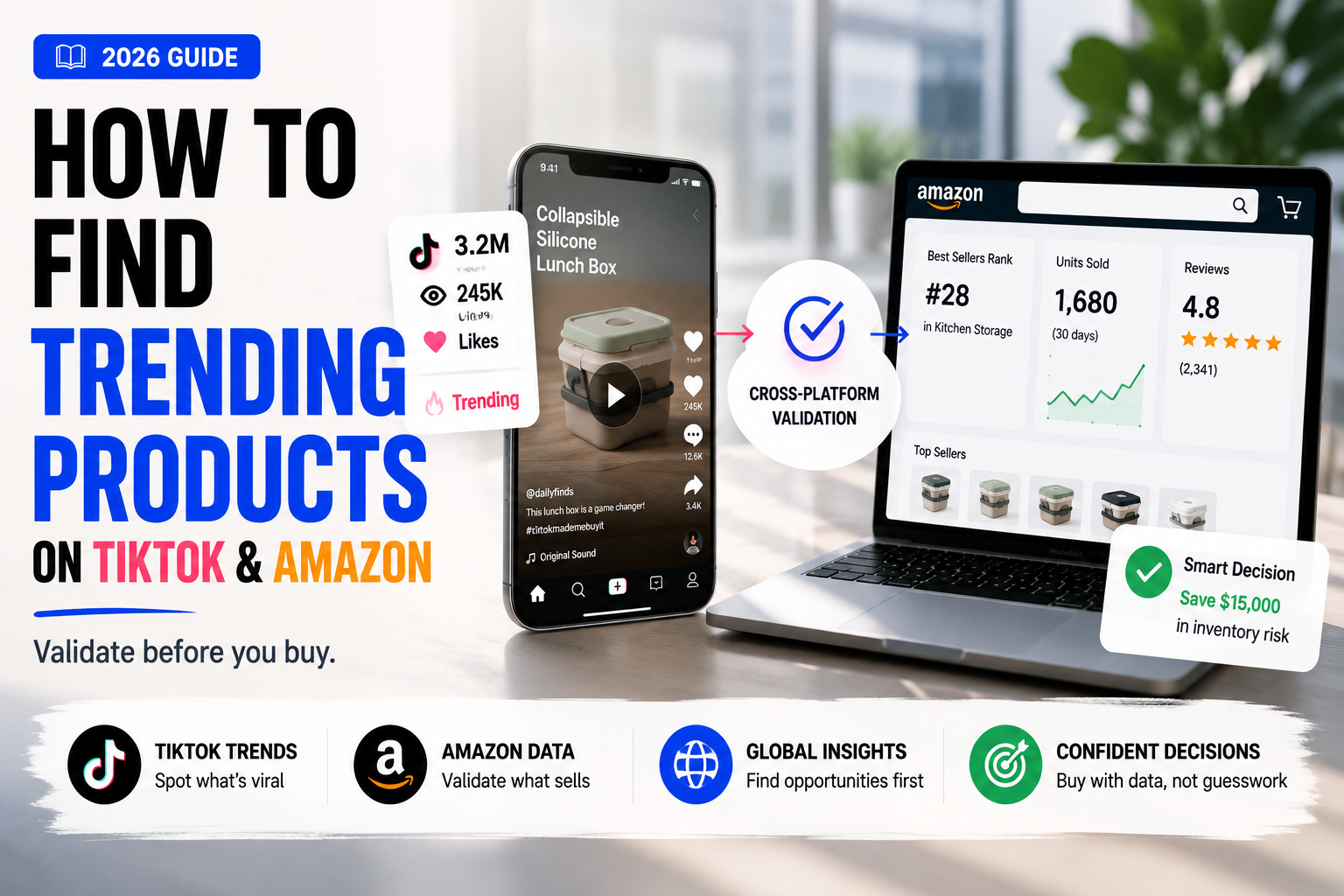
How to Find Trending Products on TikTok and Amazon (2026 Guide)
2026/07/08

How to Find Trending Products on TikTok and Amazon (2026 Guide)

Learn how to find trending products that work on both TikTok and Amazon. 2026 cross-platform research framework for DTC sellers, with real data and examples.

The best trending products in 2026 don't just go viral on TikTok, they also convert on Amazon. A product that racks up millions of TikTok views can still flop when shoppers hit the buy button, which is why cross-platform validation separates profitable sellers from those stuck with dead inventory. This guide shows you how to find trending products that win on both platforms.

Here's the problem most sellers face. Last March, Jenny spotted a collapsible silicone lunch box going viral on TikTok. The views were massive. She almost placed a $15,000 inventory order on the spot. Instead, she checked Amazon first. The TikTok buzz was real, but Amazon sales were flat, and three established sellers already dominated the category with 4.8-star ratings. She passed. Two months later, that TikTok trend fizzled while the Amazon incumbents held steady. One cross-platform check saved her $15,000.

This guide covers the cross-platform validation framework that helps you spot trending products with real staying power, not just fleeting viral moments.

Key Takeaways

  • Products trending on TikTok don't always convert on Amazon, so cross-platform validation is essential before you commit inventory
  • The TikTok Halo Effect means roughly 40% of Amazon revenue is influenced by TikTok and Meta exposure
  • Track different signals per platform: TikTok (views, KOL adoption, comment sentiment) vs. Amazon (units sold, GMV, Best Sellers Rank)
  • Region-specific research reveals localized product opportunities before they cross into Western markets
  • Unified cross-platform dashboards eliminate the manual tool-switching that slows most product research

A trending product isn't just one with high sales volume. It's a product with momentum, demand, and a clear path to monetization. The distinction matters because chasing the wrong signal costs money.

Think about the difference between a fad and a sustainable trend. Fidget spinners were a fad. They exploded, then collapsed, leaving sellers with warehouses full of unsold stock. Eco-friendly home goods, on the other hand, have grown steadily for years. Both looked "trending" at some point. Only one was worth betting on.

Here's the trap: most sellers evaluate trends using data from a single platform. They see a viral TikTok and assume demand. Or they see a high Amazon rank and assume opportunity, without realizing that rank has been locked up by entrenched competitors for three years.

Single-platform data is incomplete data. To find products worth selling, you need to read signals across both the discovery platform (TikTok) and the conversion platform (Amazon).

The TikTok-Amazon Connection: Understanding the Halo Effect

The TikTok Halo Effect describes how TikTok exposure drives sales on other platforms, especially Amazon. It's one of the most important dynamics in 2026 ecommerce, and most product research completely ignores it.

How TikTok Drives Amazon Sales

The customer journey has changed. Shoppers discover a product on TikTok, then head to Amazon to validate it, checking reviews, comparing alternatives, and taking advantage of Prime shipping before they buy.

This isn't a soft branding theory. The data backs it up. Fospha reports that roughly 40% of Amazon revenue for the brands they study is influenced by non-Amazon paid media, predominantly Meta and TikTok. Separately, analysts have found a 28% statistical correlation between TikTok views and Amazon performance, which is significant in an environment where cross-platform attribution is notoriously murky.

What this means for product research: A product's TikTok momentum is a leading indicator of Amazon demand. If you only watch Amazon, you're seeing the trend after it's already peaked.

Ready to see how top sellers track this? Explore cross-platform product discovery →

Why Some Viral Products Flop on Amazon

Not every TikTok sensation converts. Understanding why is what protects your inventory budget.

TikTok excels at impulse buys, products with a "wow" moment that makes you stop scrolling. Amazon is search-driven, where shoppers hunt for solutions to specific problems. A product that's fun to watch isn't always a product people actively search for.

Price sensitivity differs too. TikTok impulse buys cluster in the $10-30 range. Amazon buyers, arriving with intent, will spend more for perceived value. A product priced wrong for its platform stalls.

The lesson: virality proves attention, not purchase intent. You still need Amazon validation to confirm the demand is real.

TikTok vs. Amazon: Which Signals Actually Matter

Each platform tells you something different. Reading both correctly is the core skill of cross-platform product research.

On TikTok, you're measuring attention and social validation:

  • Views, shares, and comments — Raw attention metrics
  • KOL and influencer adoption — When creators pick up a product organically
  • Comment sentiment — Look for "where can I buy this?" not just "cool"
  • Multiple creators, multiple videos — A trend confirmed across many accounts is more reliable than one viral hit

The strongest TikTok signal is the same product appearing across multiple creators, multiple videos, and multiple days, with comments showing clear buying intent.

On Amazon, you're measuring actual purchase behavior:

  • Units Sold — Real purchases, not just views
  • Total GMV — Revenue scale and potential
  • Best Sellers Rank (BSR) — Relative demand within a category
  • Reviews and ratings — Product-market fit and trust (a 4.9-star product with thousands of reviews is validated)

Signal Comparison at a Glance

Signal TypeTikTokAmazon
AttentionViews, shares, commentsSearch volume, BSR
ValidationKOL adoptionUnits Sold, GMV
TrustComment sentimentReviews (e.g., 4.9★)
Price band$10-30 (impulse)$20-100+ (value-driven)
Buyer mindsetDiscovery, impulseIntent, problem-solving

When a product shows strong signals on both sides of this table, you've found something worth testing.

The Cross-Platform Product Discovery Framework

Here's a repeatable, four-step process for finding trending products that actually convert.

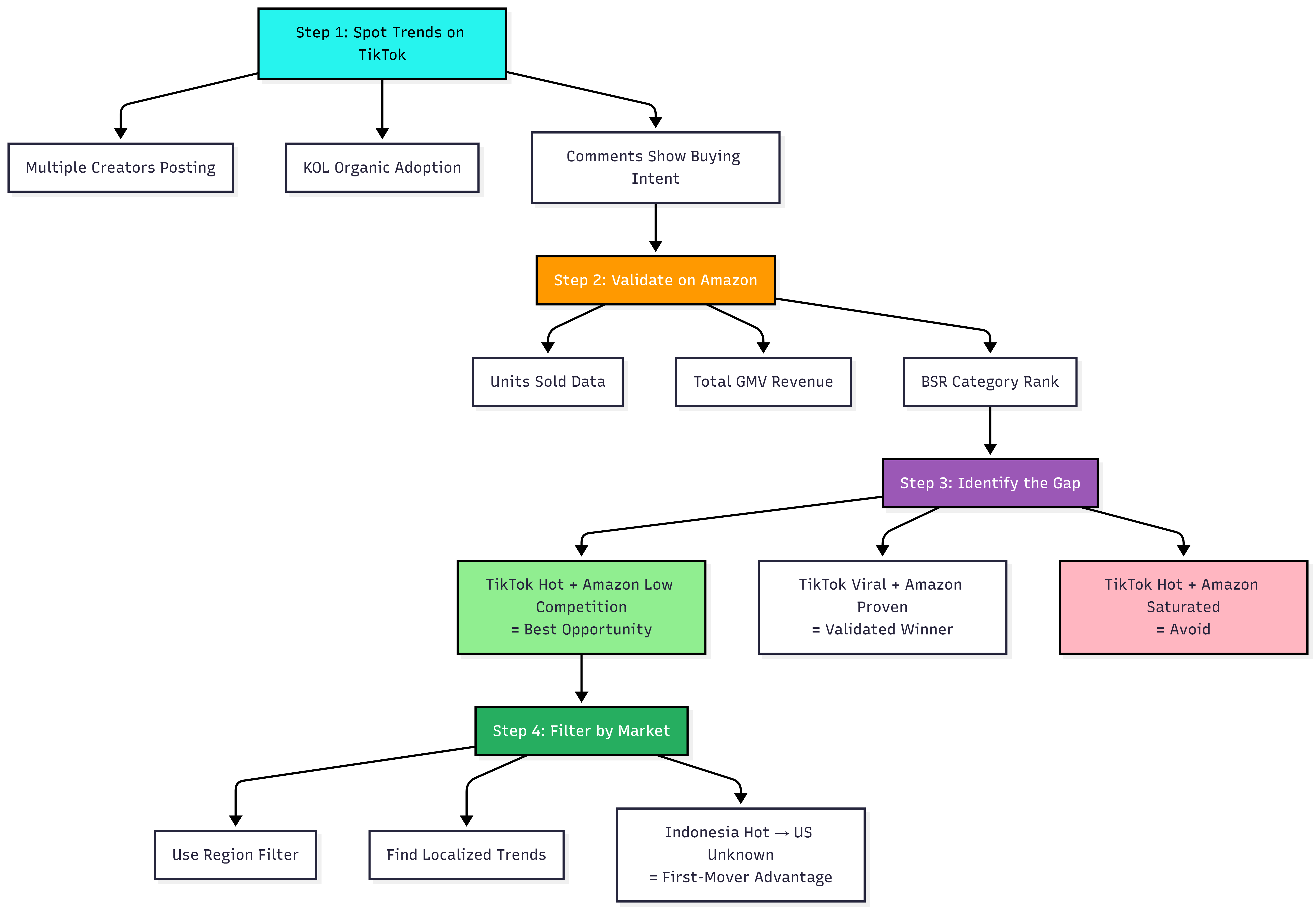
Four-step cross-platform product validation framework from TikTok discovery to Amazon validation

The 4-step framework: Spot TikTok trends → Validate Amazon sales → Identify opportunity gaps → Filter by market.

Start where discovery happens. Look for products gaining traction across multiple creators, not just a single viral video. Pay attention to products that influencers are adopting, since creator-backed products carry built-in social proof.

Check the comments. Genuine buying intent ("Link please!" "Where do I get this?") is a stronger signal than passive engagement.

Step 2: Validate on Amazon

Once you've spotted a TikTok trend, confirm it has purchase potential. Look for existing Units Sold and GMV to prove people actually buy it. Check the Best Sellers Rank and read reviews to gauge product-market fit.

Critically, assess the competition. A product with strong Amazon sales but ten entrenched sellers holding 4.8-star ratings is a hard market to crack.

Step 3: Spot the Gap (Opportunity Zones)

The magic happens where the two platforms diverge or align in your favor:

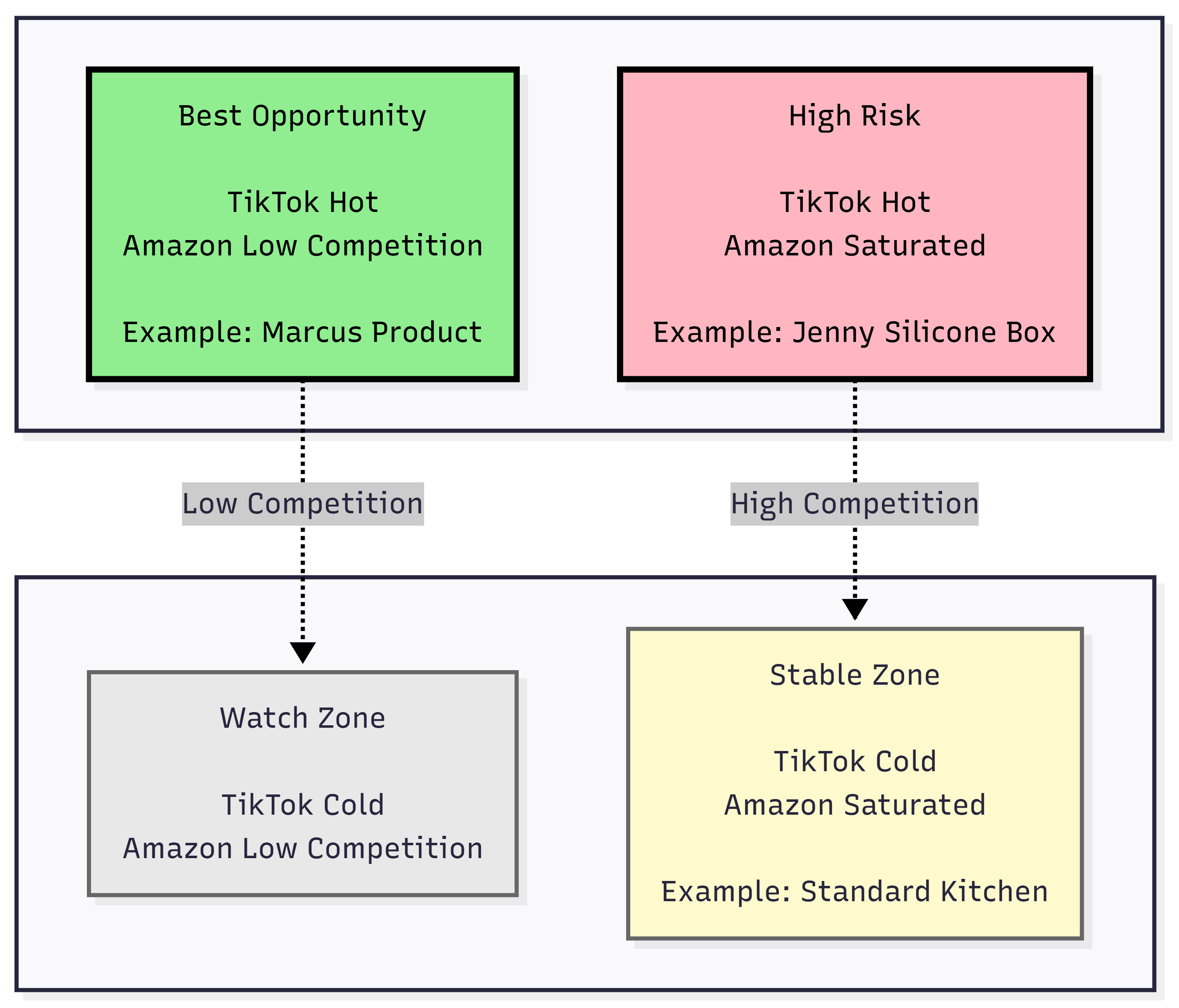
  • TikTok hot + Amazon low competition = Your best opportunity. Demand is building, but sellers haven't saturated it yet.
  • TikTok viral + Amazon proven = A validated winner. Higher competition, but lower risk.
  • TikTok emerging + Amazon growing = Early-mover advantage. Get in before the crowd.

Jenny's silicone lunch box fell into a fourth, dangerous zone: TikTok hot but Amazon saturated. Recognizing that zone is what saved her budget.

Product opportunity matrix showing TikTok momentum versus Amazon competition levels

Opportunity zones: The best products sit in the "Best Opportunity" quadrant (TikTok hot + Amazon low competition).

Step 4: Filter by Market

Trends aren't global at the same time. A product dominating one region may be unknown in another, which is where cross-border opportunity lives.

Marcus learned this firsthand. He was selling generic kitchen gadgets in the US, competing against dozens of sellers. Then he discovered a paper lunch box product dominating Indonesia's market, with 36.9 million units sold and minimal Western competition. He localized it for the US before the trend crossed over. That first-mover advantage gave him six months of low-competition sales.

Using CreatiVault for Cross-Platform Product Research

Manually cross-referencing TikTok trends with Amazon sales data means jumping between multiple tools, spreadsheets, and browser tabs. It's slow, and it's easy to miss connections.

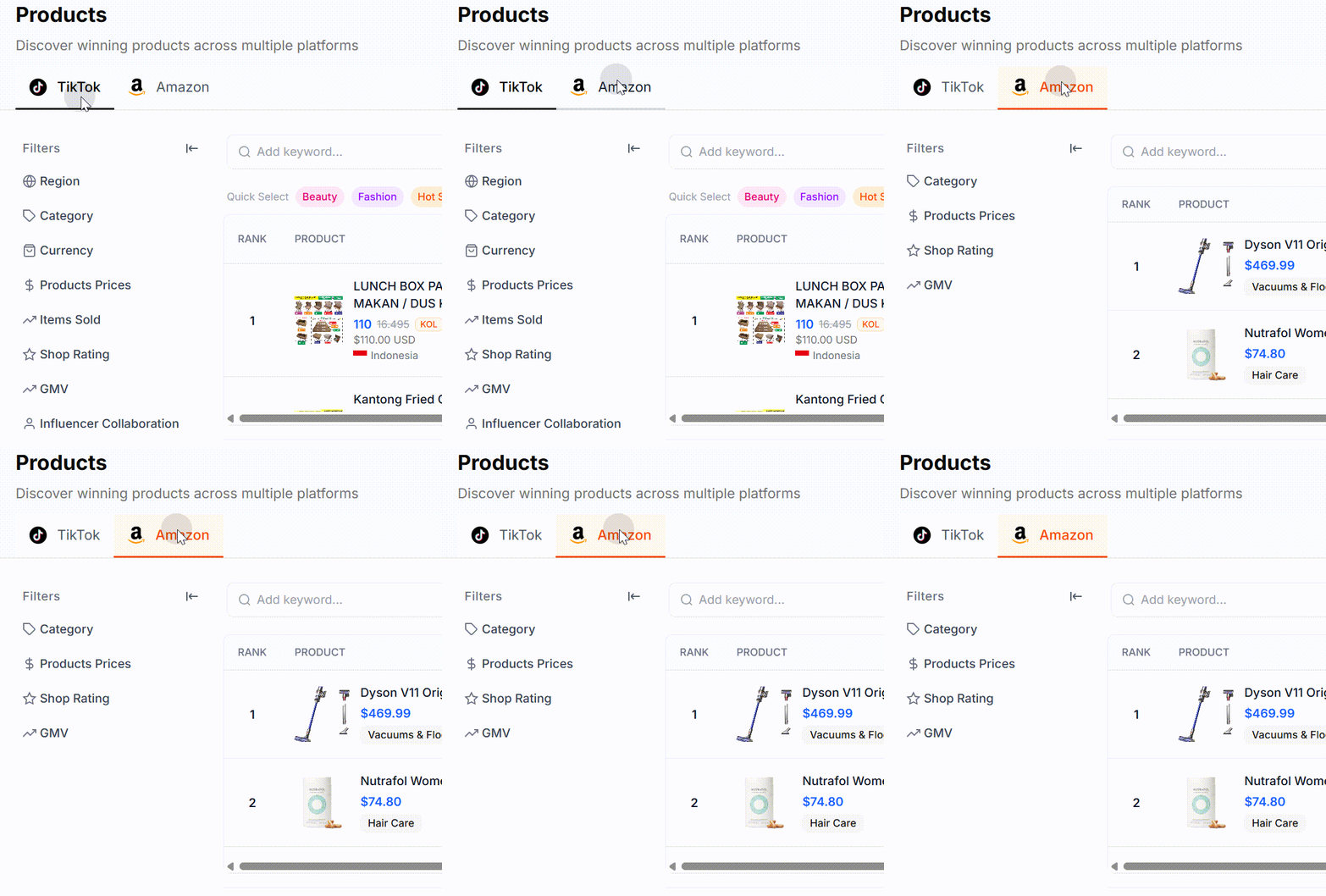
CreatiVault's Products feature unifies both platforms in one dashboard. You can toggle between TikTok and Amazon data to see how products perform across the discovery-to-conversion journey, without leaving the screen.

TikTok product research dashboard with multi-dimensional filters including Region Category and GMV

Smart filters let you narrow by Region, Category, Price range, and Shop Rating to find your exact opportunity zone.

What the dashboard surfaces:

  • Multi-dimensional metrics — Units Sold, Total GMV, and a composite Score (like a 4.9★ rating) side by side, so you're reading real purchase data, not just view counts
  • Dynamic ranking — Products ranked by performance, updated as trends shift
  • Smart filters — Narrow by Region, Category, Currency, Price range, Shop Rating, and GMV to find exactly the opportunity zone you're targeting
  • Quick Select tags — Jump straight to Beauty, Fashion, Hot Seller, or KOL Product segments

CreatiVault Quick Select tags including Beauty Fashion Hot Seller and KOL Product filters

Quick Select tags let you jump straight to Beauty, Fashion, Hot Seller, or KOL Product segments.

That last tag matters more than it looks. Sarah's team used to spend 10 hours a week manually scrolling TikTok to find products influencers were promoting. When they switched to filtering by KOL Product, they cut research time to 30 minutes. In their first week, they spotted a beauty product that 12 different mid-tier creators were promoting at once, a clear signal the brand was scaling. They jumped on the trend early.

Want to cut your product research time? See how the Products feature works →

Real Example: Deconstructing a Winning Product

Let's break down a product that ranks #1, using the cross-platform lens.

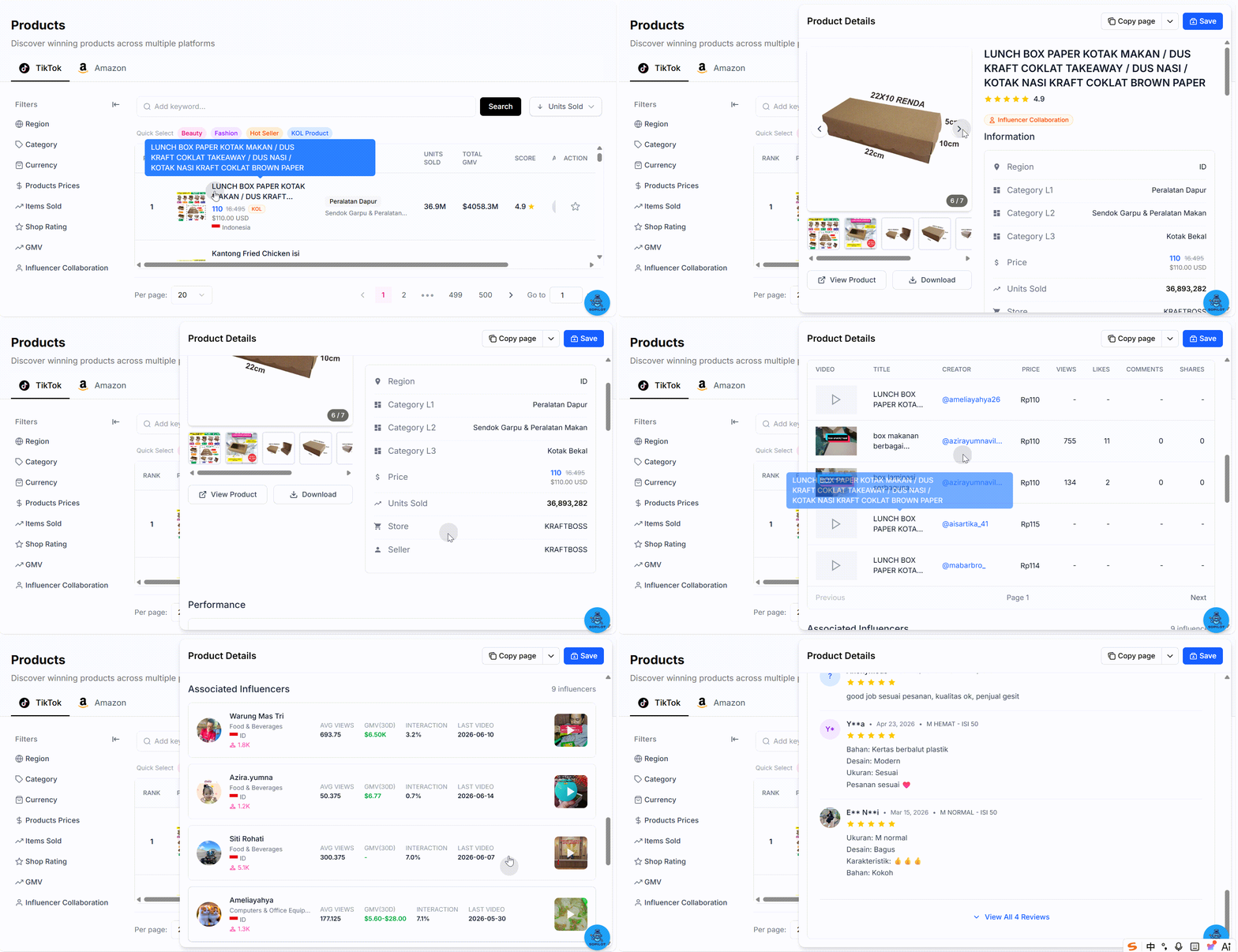
CreatiVault Products dashboard showing TikTok trending products with Units Sold GMV and Score metrics

CreatiVault's Products dashboard showing top-ranking TikTok products with multi-dimensional metrics (Units Sold, GMV, Score).

The product: A paper lunch box (kitchen equipment category), selling in the Indonesian market.

The numbers:

  • Units Sold: 36.9 million
  • Total GMV: $4,058.3M
  • Score: 4.9★
  • Price: $110 USD
  • Category: Kitchen equipment

Why it works:

The sales volume proves demand is real, not hypothetical. The 4.9-star score signals strong product-market fit and buyer trust. The high GMV shows this isn't a low-margin race to the bottom.

Most importantly, it's dominating a specific regional market. For a cross-border seller, that's a signal to watch: a product proven in one market often has runway in others before local competition catches up. The kitchen equipment category also tends toward sustainable demand rather than fad territory, since these are everyday-use items, not novelty products.

This is exactly the kind of insight that stays hidden if you only research your home market or only watch one platform.

Common Mistakes in Product Research

Even experienced sellers fall into these traps:

  • Relying on static listicles — "50 trending products" articles are outdated the moment they publish. They can't reflect real-time demand.
  • Ignoring cross-platform signals — Watching only TikTok or only Amazon gives you half the picture.
  • Chasing fads without validation — Virality feels urgent, but urgency isn't demand. Validate before you buy.
  • Missing regional opportunities — The best products are often trending elsewhere first. A US-only view misses them.
  • Not checking KOL involvement — Multiple creators promoting the same product is a scaling signal worth acting on.

Avoiding these five mistakes puts you ahead of most sellers still guessing their way through product selection.

How do I find trending products on TikTok? Look for products appearing across multiple creators and videos, not just one viral clip. Check comment sections for buying intent, and watch for products that influencers adopt organically. Consistent momentum across days and accounts signals a real trend.

How do I validate a trending product on Amazon? Check Units Sold and GMV to confirm real purchases, review the Best Sellers Rank for category demand, and read reviews to gauge product-market fit. Then assess how many established sellers already compete in that space.

What is the TikTok Halo Effect? It's the phenomenon where TikTok exposure drives sales on other platforms, especially Amazon. Roughly 40% of Amazon revenue for many brands is influenced by non-Amazon media like TikTok and Meta, as shoppers discover products on TikTok and buy on Amazon.

Should I sell on TikTok or Amazon first? It depends on the product. Impulse-friendly, visually striking products often launch well on TikTok. Search-driven, problem-solving products may perform better on Amazon. The strongest products work on both, which is why cross-platform validation matters.

How often do product trends change? TikTok trends can shift in weeks, while Amazon demand for sustainable products moves more slowly. This is why real-time data beats static lists, and why tracking momentum matters more than tracking a snapshot.

Conclusion

Finding trending products in 2026 isn't about scanning a listicle or betting on a single viral video. It's about cross-platform validation, spotting momentum on TikTok and confirming real purchase demand on Amazon before you commit a dollar of inventory.

The sellers who win read both platforms. They understand the TikTok Halo Effect, track the right signals on each side, and use regional data to find opportunities before competitors do.

Your next steps:

  1. Find 5 products currently trending on TikTok
  2. Validate each on Amazon (Units Sold, GMV, reviews, competition)
  3. Identify which fall into the opportunity zones
  4. Check whether any are trending in other regions first

Cross-platform research used to mean hours of manual tool-switching. It doesn't have to. See how CreatiVault unifies TikTok and Amazon product data in one dashboard →

The best product opportunities are hiding in the gap between what's going viral and what's actually selling. Now you know how to find them.


Sources

创意洞察,一键解锁全球营销智慧
Copyright © 2025 CreatiVault INC
All rights reserved